

Running a healthcare practice today isn’t just about delivering excellent patient care; it’s also about getting paid accurately, on time, and in full. That’s where medical billing audits step into the picture. Many providers hear the word “audit” and immediately think of trouble, penalties, or government investigations. In reality, a medical billing audit is often one of the smartest tools a practice can use to protect revenue and stay compliant.
With constantly changing payer guidelines, evolving coding rules, and increased scrutiny from insurance companies, billing errors are easier to make than ever. Even a small mistake, such as an incorrect modifier or missing documentation, can trigger claim denials, delayed payments, or, worse, payer audits that demand refunds. A medical billing audit helps catch these issues early, before they spiral into financial or legal problems.
In an environment where revenue cycle management is tightly linked to compliance, medical billing audits are no longer optional. They are a proactive strategy for identifying weaknesses, improving processes, and ensuring that medical billing, medical coding, and credentialing and enrollment workflows are aligned. Let’s break down exactly what a medical billing audit is, the different types, and how the process works in real-world healthcare settings.
What is a Medical Billing Audit?
A medical billing audit is a detailed review of a healthcare provider’s billing and coding practices to ensure claims are accurate, compliant, and properly supported by documentation. In simple terms, it’s a way to verify that the services provided to patients are billed correctly in accordance with payer rules and federal regulations.
Unlike a casual review, an audit dives deep into medical records, coding choices, claim submissions, and payment outcomes. It examines whether the services billed were medically necessary, correctly coded, and supported by proper documentation. This process helps identify errors such as overbilling, underbilling, unbundling, or misuse of modifiers.
Why Medical Billing Audits are Necessary
Medical billing audits are essential because healthcare billing is one of the most regulated financial processes in any industry. Insurance companies, Medicare, and Medicaid all have strict guidelines, and failing to follow them can lead to denied claims, audits, or repayment demands.
Audits help practices stay compliant with payer policies and reduce the risk of external investigations. They also protect revenue by identifying missed charges or undercoded services that result in lost income. In many cases, practices discover they are leaving money on the table simply because services were not billed correctly.
Role of Medical Billing Audits in Revenue Cycle Management
Revenue cycle management is the backbone of a healthcare practice’s financial health. From patient registration to final payment, every step must work smoothly. Medical billing audits play a critical role in strengthening this cycle by identifying breakdowns that disrupt cash flow.
Audits help reduce claim denials by ensuring accurate coding and proper documentation before claims are submitted. They also improve first-pass acceptance rates, meaning fewer rework efforts and faster reimbursements. When billing errors are minimized, staff can focus more on patient service instead of chasing unpaid claims.
By integrating audits into revenue cycle management strategies, practices gain better visibility into their financial performance. Audits reveal where revenue leaks occur and provide actionable insights to fix them.
Common Revenue Risks Identified Through Audits
Medical billing audits often uncover hidden risks that directly affect revenue. These include underbilling, where services are provided but not fully billed, and overbilling, which can trigger payer audits and refund demands.
Other common risks include incorrect payer selection, outdated fee schedules, and improper use of modifiers. Credentialing and enrollment issues, such as billing under the wrong provider, are also frequent audit findings. Addressing these risks not only improves compliance but also ensures consistent and accurate reimbursement.
Types of Medical Billing Audits
Medical practices can carry out a medical billing audit in a number of ways. Major forms of medical audits are listed below.
Internal Audits
Internal medical billing audits are conducted by a practice’s own staff or internal compliance team. These audits are proactive and typically performed on a routine basis, such as quarterly or biannually.
The main benefit of internal audits is early detection. They allow practices to identify and correct errors before claims are submitted or before payers notice a pattern. Internal audits also support ongoing staff education and process improvement.
External Audits
External audits are performed by independent third-party experts who specialize in medical billing and coding compliance. These audits offer an unbiased assessment of a practice’s billing processes and are often more comprehensive.
Practices typically seek external audits when preparing for payer reviews, expanding services, or experiencing high denial rates. External auditors bring industry-wide insights and can benchmark a practice’s performance against best practices.
Prospective Audits
Prospective audits review claims before they are submitted to payers. This preventive approach helps catch errors early and reduces the risk of denials or compliance issues.
These audits are especially useful for high-risk services or new providers. By ensuring accuracy upfront, prospective audits protect revenue and improve overall billing efficiency.
Retrospective Audits
Retrospective audits examine claims that have already been submitted and paid. They focus on identifying patterns of errors and recovering lost revenue or addressing overpayments.
While retrospective audits don’t prevent initial errors, they provide valuable insights for long-term improvement and compliance planning.
Government Healthcare Audits
The accountability and conformity of medical billing can only be guaranteed through government healthcare audits. These audits are carried out by government organizations to ensure that healthcare providers do not engage in fraudulent activities, appropriately charge services, and follow all rules and regulations. Medicare and Medicaid are two major programs that undergo these audits.
Medicare
Medicare audits check submitted claims for legitimacy, correct coding, and supporting evidence by reviewing medical records and billing data.
A few of the audit methods used by Medicare are RAC audits, random sample audits, and comprehensive error rate testing (CERT).
Medicaid
Similar to Medicare audits, Medicaid audits review records to verify correct documentation, medical necessity, and accurate billing to Medicaid.
An important aspect of these auditing methods is the Medicaid Integrity Program (MIP), which aims to detect, prevent, and recover incorrect Medicaid payments.
Medical Billing Audit Process Explained
A medical billing audit needs careful planning and execution. Below, we will go over the six primary processes that make up the entire process:
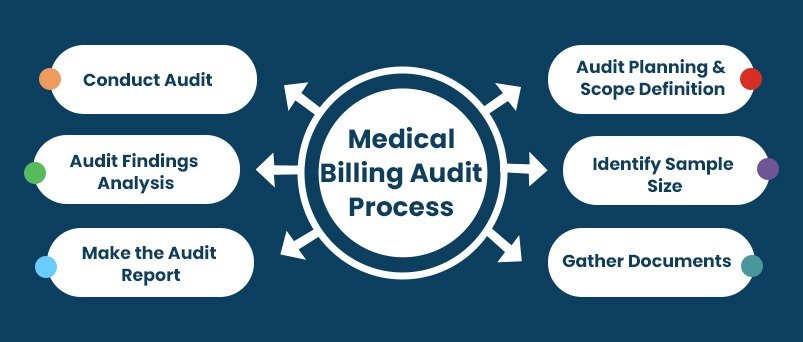
Audit Planning and Scope Definition
Random, thorough, and hybrid audits are available. Random audits select large and small claims by financial value. Effective audits thoroughly review claims and request repayments. Combining random and extensive audit methods, the hybrid audit investigates samples of all claim categories for gaps. Before choosing the audit scope and amount of claims, the practice should ensure internal/external resources and support.
Identify Sample Size
The audit sample should include a mix of patient encounters. Auditing too many documents is expensive and time-consuming, while auditing too few may distort the results.
An audit sample of 10–15 charts is typical. When auditing several physicians, the OIG recommends using RAT-STATS for a statistical sample and five to ten charts per provider.
RAT-STATS helps practices comprehend payer sampling methods. The practice can collect risk data and be proactive in compliance. If the practice recognizes these areas, audits documentation and coding, and offers variation-based education, payer audits are less likely to find hidden liabilities.
Gather Documents
After selecting the sample size and charts, practices must gather evidence necessary to determine the charts’ DOS. Lab results, papers, photos, and other data may be in the patient interaction medical record. Evaluation success requires all supporting material.
Retrospective audits require the superbill/charge ticket, patient chart, claim form, billing record, and explanation of benefits (EOB) or Remittance Advice for each patient interaction.
Get familiar with the chart’s layout and any special forms, such as the history form, problem list, and prescription sheet.
Conduct Audit
Use your tools to audit. Check the code and documentation. Be careful to follow the CPT®, ICD-10-CM, and HCPCS Level II coding books and organize your papers. Check service coding standards:
- New vs. old patients
- Consulting vs. referring
- Temporal code requirements
- Emergency medical services
- Nonphysician services; hospitals
Audit Findings Analysis
Analyze your results and find problem areas once the audit is over. For example,
- Not giving the right CPT® or HCPCS Level II codes for services or tasks.
- The documentation does not handle E/M levels.
- Incorrect diagnosis codes, such as ICD-10-CM codes that don’t provide enough information to prove medical necessity.
- Not using modifiers correctly or missing them.
- Linkage error in analysis.
- Services provided but not paid for.
Make the Audit Report
Present audit findings in a concise report. The writing should be convincing and detailed. The reader should understand the audit’s scope and process.
Determine the right and incorrect contact counts. Observe code errors and trends. To classify errors and risks, label them by CPT® code, payer, provider, or specialty. Clarify and relate all errors to the standard.
Finally, suggest fixes. Changes to documentation or training are possible. Include suggestions for a follow-up analysis to assess whether the disciplinary action worked.
RBS Innovator: Your Trusted Partner for Medical Billing Audits
In terms of income, you have many obstacles. Enhance accuracy, profitability, and peace of mind with RBS Innovators’ audit solutions. We’ll help you improve gaps in your compliance program and resolve critical concerns.
To maximize payments while keeping compliant, we have a history of effectively supporting medical practitioners in several sectors. In addition to auditing medical bills, we offer a wide variety of other top-notch services, such as:
- Medical Billing
- Revenue Cycle Management
- Medical Coding
- Credentialing and Enrollment
Frequently Asked Questions (FAQs)
Q1. How often should medical billing audits be conducted?
Ans. Most practices benefit from quarterly internal audits and annual external audits.
Q2. Are medical billing audits mandatory?
Ans. While not always required, audits are strongly recommended to maintain compliance.
Q3. Can audits increase practice revenue?
Ans. Yes, audits often uncover underbilling and missed charges.
Q4. What specialties need audits the most?
Ans. High-volume and high-risk specialties benefit the most from regular audits.
Q5. How long does a medical billing audit take?
Ans. The timeline varies but typically ranges from a few weeks to a couple of months.
Conclusion
Audits of medical bills might be beneficial for medical offices. They can help protect processes from financial losses, legal problems, and reputational damage. Profitability and the quality of patient care can both be enhanced with their help. Practices should think about doing an audit of their medical billing. It is a financial commitment that could help your business and make more money.