
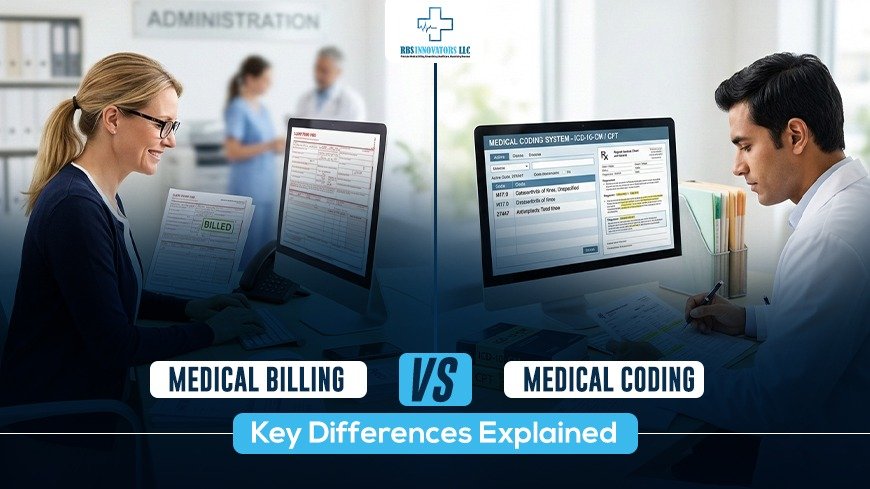
Ever feel like healthcare speaks its own secret language? You are not alone. People often confuse the terms as if they’re the same job. But in the medical world, they are the two sides of the coin.
While medical billers and coder often sit at the same desk and use similar software, their missions are totally different. One focuses on the clinical story of your visit, while the other focuses on the financial transaction that keeps the clinic running.
The coder is the person who translates complex medical records into universal codes, while the biller is the negotiator who takes those codes and ensures insurance payments are processed. One focuses on clinical information, while the other focuses on financial transactions.
So, why is understanding the difference between these two terms important?
Because knowing the truth saves you from career mistakes and helps you decode your own medical bills. In this post, we will break down the topic into medical billing vs medical coding, explore how they work together in the revenue cycle, and help you understand which path might be the right fit for your career goals.
By the end, you’ll have a clear understanding of why both roles are indispensable pillars of a functioning healthcare system.
What is Medical Billing
Medical billing is the financial backbone of healthcare. It’s the process of taking the codes from a patient’s visit and turning them into an insurance claim, and then chasing down payment until the provider gets paid and the patient’s balance is clear.
If medical billing didn’t exist, healthcare providers wouldn’t get paid reliably, and that could mean fewer resources for patient care, longer wait times, or even practice closures.
Key Responsibilities
Medical billers submit claims to insurance companies and follow up on insurance payments to ensure healthcare providers receive proper reimbursement. For example, a medical biller:
- Check if a patient’s coverage is active before the appointment.
- Take the codes provided by the coder, insert them into the proper forms (like the CMS-1500), and send them to insurance companies electronically.
- When an insurance company rejects a claim, the biller investigates why, fixes errors, and appeals the decision.
- Billers often communicate with insurance representatives, patients with billing questions, and office staff to clear up confusion.
- Once payment arrives, they apply it correctly and bill the patient for any remaining balance (like copays or deductibles).
What is Medical Coding
Medical coding is the process of converting medical diagnoses, procedures, and services into standardized alphanumeric codes, like ICD-10, CPT, and HCPCS. These codes tell about what was treated, why it was treated, and how, all in a format computers and insurers can process instantly.
For example, a doctor spends 15 minutes with a patient, writing notes about symptoms, tests, and treatments. Now imagine that entire visit needs to be translated into a universal language that insurance companies, hospitals, and government agencies around the world can understand, without losing a single detail. That’s medical coding. It’s not just data entry; it’s healthcare translation.
Key Responsibilities
- Review doctor’s notes, lab results, and procedure reports to understand the full clinical picture.
- Assign the right code, ICD-10-CM for why the patient was seen (diagnoses like “J45.909” for asthma), CPT for what was done (procedures like “99213” for an office visit), and HCPCS Level II for what supplies were used (like crutches, vaccines, or ambulance rides).
- Follow strict rules to avoid fraud, audits, or claim denials. Accuracy is important for quick reimbursement
- If documentation is unclear, coders query providers to ensure the record matches the code.
- Handle sensitive health information with HIPAA-level confidentiality.
In the healthcare system, if medical coding asks, “What happened during the visit?” then medical billing asks, “Who pays for it, and how do we get that money?” Both are essential but play different roles that work together.
Medical Billing vs Medical Coding
| Feature | Medical Coding | Medical Billing |
| Focus | Clinical accuracy and documentation | Revenue collection and claims processing |
| Primary Question | “What codes match this patient visit?” | “How do we get this claim paid?” |
| Works With | Doctor’s notes, lab reports, EHRs | Insurance portals, patients, and payment systems |
| Key Tools | ICD-10, CPT, HCPCS codebooks; encoder software | Practice management software; payer portals |
| Daily Interactions | Providers, clinical staff | Insurance representative, patients, and finance teams |
| Goal | A perfectly coded, compliant medical record | A paid claim and a satisfied patient balance |
| When It Happens | Right after the patient visit | After the codes are assigned |
| Skill | Analytical thinking and medical knowledge | Communication, problem-solving, and persistence |
| Common Certifications | CPC (AAPC), CCS (AHIMA) | CPB (AAPC), CBCS (NHA) |
- Coding always comes first. A biller can’t submit a claim without codes.
- Coders mostly chat with doctors and nurses to clarify documentation. Billers are on the front line with insurance companies and patients.
- A wrong code assigned means a claim is denied for medical necessity or incorrect procedure. The right code, wrong submission results in a claim rejected for missing info or timely filing. Both damage the revenue in the same way.
- A good coder gives the biller a clean, defensible claim. A great biller gives the coder feedback on what payers are denying.
How They Work Together
It starts from the moment the patient leaves the exam room. After a provider documents the visit, for example, treating a sprained ankle with an X-ray and a brace, the medical coder’s job starts. Their job is to read those clinical notes and translate them into universal codes: ICD-10 for the diagnosis, CPT for the procedures, and HCPCS for any supplies used.
This isn’t just typing numbers; it’s about capturing the full story of care with precision. Once the codes are locked in, the coder hands off a clean, compliant chart to the billing team.
From there, the medical biller takes the turn. They use those codes to build an insurance claim, verify the patient’s coverage, and submit everything electronically to the payer. But their work doesn’t stop there. They track the claim throughout and ensure that it is received, approved, and paid.
If the insurance company denies the claim, maybe for a missing modifier or a prior authorization issue, the biller investigates. Often, they move back to the coder and clarify all the things regarding coding and documentation. This back-and-forth isn’t a sign of failure; it’s the system working as intended. They analyse, appeal, and resubmit the claim together until the claim is resolved.
When the insurance payment finally arrives, the biller posts it, calculates the patient’s remaining balance (like a copay or deductible), and sends a clear, easy-to-understand statement. If the patient has questions, the biller explains it using the coder’s work.
And finally, the provider gets paid for their care, the patient understands their financial responsibility, and the clinic can keep functioning. It’s a seamless process where accuracy on the coding side prevents headaches on the billing side, and sharp billing practices give coders valuable feedback on what payers are looking for.
Career Path
Choosing between a career in medical billing or medical coding depends on understanding your natural strengths and what kind of workday energizes you. Both paths offer incredible opportunities in healthcare administration, stable demand, remote work potential, and the chance to make a real impact without direct patient care, but they attract very different personalities.
If you’re the type of person who loves puzzles, thrives on details, and gets satisfaction from finding the one right answer hidden in a stack of clinical notes, medical coding might be easy and suitable for you.
Coders spend their days translating complex medical documentation into universal codes, which means you’ll focus on the anatomy, medical terminology, and compliance guidelines. It’s focused, independent work that rewards precision and patience, and it often comes with strong remote opportunities once you’ve built your experience.
On the other side, if you’re a people-person who enjoys problem-solving through communication, medical billing could be your perfect match. Billers are the connectors of the healthcare revenue cycle: they verify insurance, submit claims, chase down denials, and explain bills to patients.
When you think about training and growth, both paths are accessible without a four-year degree. Many coders start with a certificate or associate program focused on ICD-10, CPT, and HCPCS code sets, then earn credentials like the CPC from AAPC or CCS from AHIMA to boost their credibility.
Billers often begin with training in insurance protocols, practice management software, and claims processing, with certifications like the CPB helping them stand out. Salary-wise, both roles offer solid entry points, typically in the $40K–$55K range, with room to grow into senior specialist, auditor, or management positions that can reach $65K–$75K or more.
Many professionals start in billing and also flourish into coding (or vice versa), and that dual expertise makes you incredibly valuable. Some even evolve into revenue cycle management, compliance auditing, or practice leadership. Ultimately, there’s no better choice; it depends only on the path that aligns with how you like to work, what you enjoy learning, and the kind of impact you want to make.
Frequently Asked Questions(FAQs)
Q1: Which role earns more?
Ans. On average, certified medical coders tend to earn slightly more than billers, but experience, specialization, and location matter more than the title alone.
Q2: Do I need to know medical terminology?
Ans. Yes, for both roles. Coders need it to assign accurate codes while billers need it to understand claims and explain charges.
Q3: How do medical billing services improve revenue cycle management for hospitals?
Ans. Medical billing services organize revenue cycle management for hospitals by reducing claim denials, accelerating reimbursements, and ensuring compliance. It turns complex clinical documentation into clean, paid claims faster and more accurately.
Q4: Which is easier, medical billing or coding?
Ans. Neither is universally easier; it depends on your strengths. Coding demands deep attention to clinical detail and rules, while billing requires strong communication and problem-solving skills with insurance systems.
Conclusion
Medical billing and medical coding may share the same stage, but they play very different roles in healthcare. Coding translates clinical care into a coding language, and billing turns that language into revenue. One focuses on accuracy, the other on action, but both are essential to keeping healthcare running smoothly.
Whether you’re a patient, provider, or aspiring professional, understanding these dynamic concepts helps you understand and appreciate the invisible teamwork behind every bill, every claim, and every paycheck that keeps healthcare functional.