
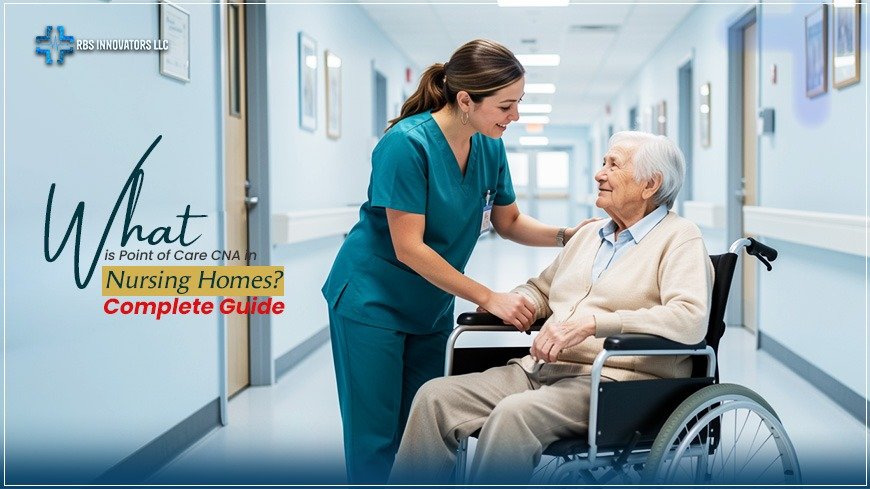
For centuries, Certified Nursing Assistants (CNAs) have faced the same end-of-shift challenge, relying on memory to document hours of care and treatment after the hectic days. A lot of valuable time is wasted running back to the nurses’ station to fill out paper charts and manage urgent resident needs. This old approach not only adds administrative burden, but it can also affect the accuracy of resident information.
Implementing a point of care CNA nursing home plan is more than just going paperless. It also requires prioritizing direct care time and maintaining data accuracy.
In this comprehensive guide, we’ll look at what point of care CNA is, the benefits of point of care charting, how CNAs utilize it in their daily routines, and what to look for in nursing home point of care software. This blog helps you, whether you are an administrator wishing to enhance your CNA documentation system or a CNA interested in electronic charting for CNAs.
What is the Point of Care CNA?
At its foundation, point of care CNA refers to the practice of documenting resident care at the time and place where it is delivered, usually immediately at the bedside. Rather than waiting until the end of a job or shift to submit information at a central nurses’ station, CNAs enter data just after giving care using mobile equipment such as tablets, handheld scanners, or wireless carts.
Traditional Vs point of care workflow
| Traditional workflow | Point of care workflow |
| CNA provides care and records everything in mind. | CNA provides care and records immediately on a mobile device. |
| Walks to the nurses’ station to chart. | Charts while still in the resident’s room. |
| Risk of forgetting details or mental stress. | Information is recorded accurately while fresh. |
| Paper charts can be lost, illegible, or delayed. | Digital entries are time-stamped, secure, and instantly available to the care team |
While registered nurses and licensed practical nurses also benefit from point of care technology, point of care CNA tools are specifically designed with the frontline caregiver in mind.
CNA Point of Care Documentation
One of the most revolutionary features of implementing a point of care CNA system is the fundamental shift it causes in everyday workflow. For CNAs, time is the most valuable resource. Every minute spent trekking to a charting station or deciphering handwritten notes means less time spent with residents. Let’s look at how CNA point of care documentation improves the flow of a shift.
Traditional Paper-Based Workflow
- CNAs help residents with morning care, like bathing and dressing
- CNAs are required to note every minute detail in their mind, such as Mrs. Smith ate 50% of lunch and Mr. Jones had a small scratch on his elbow.
- They have to walk to the nurses’ station to document everything many times during one hour.
- CNAs take notes from memory, which might result in missed details, transposition errors, or unreadable handwriting.
- Other team members may not receive updates until the chart is physically returned to the station.
Modern Point of Care Workflow
- CNA provides a resident with morning care while keeping a safe mobile device or handheld tablet nearby.
- Following the task, the CNA opens the point of care charting CNA app, selects the resident, and records the care provided.
- The system may ask for essential information, highlight abnormal vitals, or recommend follow-up activities in the moment.
- Documentation occurs in the room. The CNA goes directly to the next resident.
- Nurses, therapists, and supervisors receive immediate access to the updated data, allowing for more efficient and coordinated care.
How CNAs use Point of Care Charting
Understanding how CNAs utilize point of care charting helps to demystify the technology and emphasize its user-centered design. Here’s a typical workflow for a tablet-based CNA documentation system:
Secure Login
- The CNA accesses the mobile device via a unique PIN, badge scan, or biometric authentication.
- The interface shows their designated resident list for the shift.
Select Resident and Task
- After delivering care (such as aiding with toileting), the CNA taps the resident’s name.
- A simple, icon-driven menu opens, with options for toileting, vitals, intake/output, skin check, and behavior notes.
Document with Minimal Typing
- Pre-set options: Rather than creating paragraphs, the CNA chooses pre-set options.
- Toileting options: Independent, assisted x1, incontinence care provided.
- Check the skin: No redness, area monitored, barrier cream applied.
- Vitals: Numeric fields with automatic alerts for out-of-range values.
- Voice-to-text or quick-select phrases: help to reduce typing.
Review and Submit
- The CNA checks the entry for accuracy.
- With a single tap, the data is submitted, promptly timestamped, encrypted, and synced to the central EHR.
Communicate (If Needed)
- If the CNA notices an issue (for example, fresh skin breakdown or a behavior change), the system allows them to mark the record for nurse evaluation or email a secure in-app alert.
Key Features
Effective electronic charting for CNAs is more than just scanning paper forms. The systems include the following:
- Offline mode: Documentation continues even if Wi-Fi is unavailable; data syncs promptly when reconnected.
- Large, Touch-Friendly Buttons: It is easy to use with gloves or in a hurry, and it reduces input errors.
- Customizable Quick-Select Lists: Facilities can tailor options to their most common care duties, resulting in a faster entry.
- Visual Cues & Alerts: Color-coded flags indicate incomplete care, abnormal vital signs, and new care plan requirements.
- Minimal Typing Required: Features like drop-downs, checkboxes, and voice input keep documentation fast and accurate.
Benefits of Point of Care Charting
Adopting a point of care CNA system is about more than just modernizing technology; it’s about achieving measurable increases in care quality, employee happiness, and operational efficiency. When paperwork moves to the bedside, everyone benefits. Let’s look at the major advantages of point of care charting for those who matter most: residents and the CNAs who care for them.
- One of the main benefits of CNA point of care documentation is a significant boost in data accuracy. When CNAs record information in real time, while details are still fresh, the likelihood of errors is greatly reduced.
- Modern nursing home point of care software is built with regulatory compliance in mind. Features include: mandatory field prompts, automatic time-stamping, HIPAA-compliant encryption, and care plan alignment.
- Perhaps the most recognized benefit of point of care charting among CNAs is the ability to devote more time to what is most important, caring for the residents.
- A CNA documentation system that updates in real time changes how information moves within a facility. CNAs are the eyes and ears of resident care, and point of care technology ensures that their observations reach the appropriate individuals at the right time.
- It also reduces the cost of paper by spending less on forms, storage, and printing supplies.
- New certified nursing assistants can learn a consistent, intuitive digital workflow faster than navigating paper systems.
- Ensures staff empowerment. CNAs feel their contributions are visible, valued, and integral to the care plan.
- Less time spent on paperwork means more time to spend on residents’ care.
Choosing the Right Electronic Charting for CNAs
Choosing the correct nursing home point of care software is an important decision that affects daily workflows, staff satisfaction, and resident care quality. Here are some features to consider while selecting electronic charting for CNA solutions.
Usability and Design
- The UI is intuitive and icon-driven.
- Customizable quick-select menus.
- The touchscreen is glove-friendly.
- Must have voice-to-text capability.
- Multiple languages supported.
Functionality
- Offline mode.
- Real-time sync with EHR/EMR.
- Smart alerts and prompts.
- Role-based access.
Compliance and Security
- HIPAA-compliant encryption.
- Regulatory alignment.
- Automatic backups.
Technical Support
- Device flexibility.
- Long battery life.
- 24/7 technical support.
- On-site or virtual training.
Frequently Asked Questions(FAQs)
Q1: Is it difficult for non-tech-savvy CNAs to chart points of care?
Ans. No, modern electronic charting for CNAs uses intuitive, icon-based interfaces with minimum typing.
Q2: Do electronic charting for CNAs violate HIPAA?
Ans. No, respectable CNA documentation system platforms are entirely HIPAA-compliant, with encrypted data transmission, secure login mechanisms, and audit trails to ensure resident privacy.
Q3: How much time does point-of-care charting save per shift?
Ans. CNAs typically save 30-60 minutes per shift by eliminating the time spent visiting the nurses’ station.
Key Takeaways
Point of Care CNA technology shift documentation from a laborious duty to a flawless component of compassionate, resident-centered care, increasing accuracy, saving time, and empowering your frontline personnel. By adopting it, CNAs reduce the time spent on manual documentation, securing their time for resident care.