
Think about a surgeon preparing for surgery, but finding out there is no instrument on the tray when needed. Imagine a nurse spending 15 minutes just to find a common medication somewhere in the central supply. Consider an emergency room patient who waits ninety minutes, not because of a lack of doctors at the facility, but because of delays in the process of discharge documentation. This is not a list of occasional mistakes but of systemic problems costing healthcare facilities millions of dollars each year.
Let’s reverse this scenario. Think about what would happen if all stages of a patient’s treatment were carefully crafted to remove the invisible inefficiencies that hinder processes and prolong recovery? This is where Lean Healthcare comes into play.
In this guide, you will learn about the best Lean Healthcare methodologies that leading organizations rely on, find out which Lean healthcare techniques provide the fastest results, and their key benefits.
What is Lean Healthcare?
Lean Healthcare can be described as an approach to achieving better patient outcomes through the continuous elimination of waste and the creation of value. To really understand the concept of Lean Healthcare, however, one should not limit oneself to just the definition but go deeper to appreciate it as a cultural revolution that is transforming healthcare facilities around the world.
Core Philosophy
As the title suggests, Lean Healthcare approaches conventional management practices from an opposite angle. Whereas conventional management asks, “What can we do to ensure that everyone is occupied?” Lean Healthcare asks,
“What does the patient truly value, and how do we deliver more of that, with less waste?”
This patient-first perspective guides every decision made in the name of Lean. Value is not determined by providers, payers, or managers but by patients themselves. The question then becomes: Does the procedure help diagnose the patient, treat him, make him feel comfortable, or reassure him?
The 8 Wastes of Healthcare
There are eight types of waste that lean identifies as the things that plague the healthcare system, and it is commonly known by its acronym DOWNTIME.
| Waste Type | Healthcare Example |
| Defects | Medication errors, mislabeled specimens, and incomplete documentation. |
| Overpopulation | Unnecessary tests, duplicate imaging, excessive reporting. |
| Waiting | Patients in waiting rooms, staff waiting for approvals or equipment. |
| Non-Utilized Talent | Clinicians are spending time on administrative tasks instead of patient care. |
| Transportation | Unnecessary transfer of patients, samples, and records from one department to another. |
| Inventry | Overstocked supplies are expiring, or critical items are frequently out of stock. |
| Motion | Nurses walking excessive distances to retrieve supplies or information. |
| Extra-Processing | Duplicate entries of data, unneeded transfers, and unnecessarily long approval processes. |
Addressing these wastes systematically results in more time and energy for the really important things in life, quality care, and patient safety.
What Lean Healthcare Is Not
Misconceptions can undermine implementation even before it begins. Here’s what we need to get straight:
- Lean is not about cutting staff or lowering quality. It’s about removing barriers so people can practice up to their license level.
- Lean is not an occasional cost-saving effort. It’s a culture of continual improvement built into everyday activities.
- Lean is not about making care too standardized. It’s about building reliable systems that enable clinicians to provide customized care for each unique patient.
How Lean Differs from Traditional Healthcare Management
| Traditional Approach | Lean Approach |
| Concentration on the efficiency of departments. | Concentration on the value stream of patients. |
| Decision-making from the top. | Empowerment of employees to solve problems. |
| Problem-solving reactive. | Prevention is proactively managed using data. |
| Success is achieving the budget. | Success is improving results and minimizing waste. |
| Forced change. | Learning-based change. |
Lean Principles in Healthcare
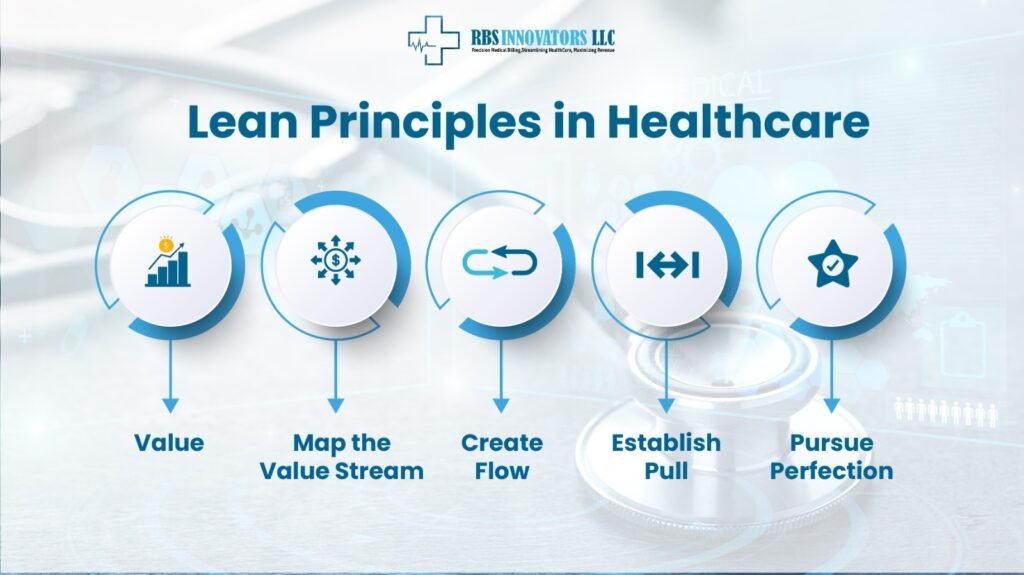
Although there may be different methods and approaches used by different organizations for the same process, it is evident that every successful Lean Healthcare project depends on five core values:
Value
Respect for people, continuous improvement, quality focus, teamwork, and patient-centricity are among the key values of this methodology. These values are used when applying the Lean framework in order to make sure that the provided health care is effective and efficient.
Map the Value Stream
This entails breaking down every phase of the healthcare process in order to establish whether that particular phase adds value to the patient or not.
Create Flow
This means ensuring that each step in the process occurs smoothly and without delays or interruptions, allowing for a frequent progression of care.
Establish Pull
Establish Pull means developing a process wherein patients dictate the supply of services instead of forecasting the number of supplies needed. This will lead to more efficient use of resources, lower instances of overproduction, and avoidance of surplus inventories.
Pursue Perfection
The Lean Approach focuses on the elimination of wastes and the improvement of patient-value flows.
Top Lean Healthcare Models & Frameworks
Lean practices based on Lean thinking principles, in their own unique way, form what is referred to as a Lean Healthcare model. Learning about these models will help you choose an appropriate one for your own organization.
Virginia Mason Production System (VMPS)
Developed by: Virginia Mason Medical Center.
Often referred to as the “gold standard” of Lean in healthcare, VMPS was among the first complete implementations of the Toyota Production System in a medical facility.
Characteristics Include
- All design projects begin with “How do we keep the patient safe?”
- Management executes standardized work each day to help staff members.
- Production Preparation Process (3P) is a highly disciplined technique used for planning new processes or facilities before implementation.
- Any employee is empowered to pull an “andon cord” if there is a danger to patient safety, like at a Toyota plant.
Companies that are prepared to undertake company-wide cultural change with strong executive backing.
ThedaCare Business System (TBS)
Developed by: ThedaCare
The ThedaCare model focuses on frontline improvement, which involves daily management and sustainability.
Characteristics Include
- Standardized processes for addressing problems and growing employees into improvement specialists.
- Brief meetings where progress toward targets is discussed, obstacles are tackled, and priorities are aligned.
- Specialized units that facilitate cross-functional optimization of workflows.
- Performance metrics that consider patient-centric outcomes (e.g., rapid pain relief, clear discharge instructions).
Medium-sized health organizations that need improvement through employee involvement but cannot afford large initial expenditures.
Cincinnati Children’s Lean Model
Developed by: Cincinnati Children’s Hospital Medical Center.
Tailored specifically for pediatrics, this version combines Lean principles with family-centered design and care coordination.
Characteristics Include
- Includes patient touchpoints (e.g., parking, communication) as well as clinical processes.
- Divides large processes into testable modules to iterate quickly.
- Integrates Lean practices with human factors engineering to eliminate variation.
- Patient or family involvement in process redesign meetings.
It is suitable for Pediatric facilities and high-need organizations.
Hybrid & Emerging Frameworks
Lean and Agile Healthcare
Quick adaptation to changing demands (for example, due to the pandemic). It is best for emergency rooms, public health care system.
Lean Digital Health
It involves the use of Lean and EHR optimization, as well as the use of telehealth services. It is suitable for healthcare systems that are making investments in digitization.
Community-Centered Lean
Expanding value streams from hospital premises to the broader environment, including socio-economic factors. This framework is appropriate for Accountable Care Organizations (ACOs) and FQHCs.
How to Choose the Right Model for Your Organization
To choose the right model for your organization, you have to ask certain questions:
- What’s our primary goal?
- What’s our change capacity?
- Who will lead the work?
- What’s our timeline?
Lean Healthcare Tools and Techniques
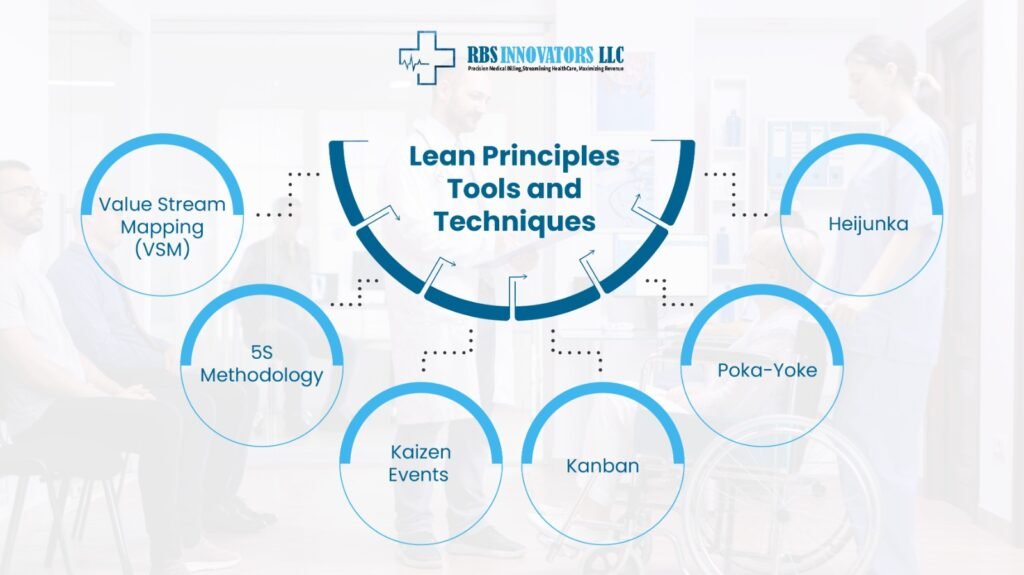
Philosophy guides you, but tools provide momentum. It is through the use of effective tools that Lean Healthcare really comes into its own by providing methods for identifying waste, implementing solutions, and sustaining those improvements. The following are the most useful tools of Lean healthcare, customized for healthcare environments with practical applications.
Value Stream Mapping (VSM)
“Visualize the entire patient journey to expose hidden waste.”
Description
It is a graphic representation of all activities in a process, from scheduling to discharge, divided into value-added and non-value-added activities.
Application in Healthcare
For instance, create a door-to-disposition process map in an emergency room to spot inefficiencies in triage, imaging, or bed allocation, or plot the path of a laboratory sample from collection to reporting to reduce its turnaround time. Make sure to track the time stamps and hand-offs; those are usually the areas where inefficiencies commonly lie.
5S Methodology
“Create organized, intuitive workspaces that reduce errors and save time.” It is made up of five Japanese principles, each one beginning with the letter “S”:
| S | Healthcare Example |
| Sort | Get rid of expired drugs, duplicate forms, and excess equipment in nurse stations. |
| Set in order | Use shadow boards to indicate where things should be stored in the drawers. |
| Shine | Conduct a daily five-minute clean sweep in procedure areas. |
| Standardize | Have pictures indicating how crash carts should look in different departments. |
| Sustain | Have frontline staff conduct 5S audits with simple scorecards. |
Kaizen Events
“Focused, time-bound bursts of collaborative problem-solving.”
Description
It contains a 3-5 day intense workshop. Cross-functional group (clinicians, administrators, IT, patients). Its scope is very clear, and that is to reduce the OR turnaround time from 45 minutes to 30 minutes. Usually finishes with changes made + 30-day plan afterwards.
Application in Healthcare
Kaizen on the discharge process for a Midwest healthcare system decreased the length of stay by 0.8 days, providing 12 additional beds each month.
Kanban
Make problems and status visible at a glance.
Description
Andon Lights
Bed condition alerts using color-coded lights on nursing stations (Green = Ready, Red = Requires Cleaning).
Kanban Cards
Automatic replenishment of frequently used materials based on reaching a predetermined low stock level, thus avoiding stockouts and excess ordering.
Performance Boards
Dynamic scoreboards are displayed in the workplace that monitor daily performance against set objectives in terms of wait times, safety measures, or patient satisfaction.
Application in Healthcare
Minimizes foraging and facilitates the resolution of potential problems before they become serious.
Poka-Yoke
A technique developed to ensure that errors do not happen by accident, but instead create an obvious indication when something goes wrong.
Description
Poka-Yoke is a practice that emphasizes the integration of fail-safe measures into the process. In other words, it refers to measures that are either physical or procedural and ensure that mistakes are simply impossible.
Application in Healthcare
Tubing connectors (like enteral feeding tubes) are designed with unique shapes so they cannot be physically plugged into an intravenous (IV) port, preventing fatal medication errors.
Heijunka
“Leveling the amount and types of production within a set time period.”
Description
Heijunka does not use batching, which means doing a large number of activities at once, resulting in unevenness. With Heijunka, a business can satisfy customer demand reliably without overextending itself during busy times and underutilizing its capacity during low times.
Application in Healthcare
An outpatient clinic would schedule different appointments with a mix of procedures during the day instead of concentrating all complex surgeries on Mondays and all simple procedures on Fridays.
Lean vs Six Sigma Healthcare
For an organization that seeks to improve its healthcare process, there are two major methodologies that will be discussed. These methodologies include Lean and Six Sigma. Despite having similar goals, the two have different uses and require distinct tools. Knowing their differences will assist you in utilizing them appropriately.
| Dimension | Lean Healthcare | Sigma Healthcare |
| Primary Focus | Waste elimination, flow optimization, and faster delivery. | Variation reduction, defect elimination, precision improvement. |
| Core Questions | What activities do not create value for the patient? | Why is there variability in this process? |
| Core Tools | Value stream mapping, 5S, kaizen, kanban. | DMAIC (define-measure-analyze-improve-control), statistical process control, and root cause analysis. |
| Results Timeline | Usually quick (days/weeks through kaizen events). | More typically slow (weeks/months in data gathering and analysis). |
| Ideal Applications | Workflow delays, organizing space, and reducing waiting times. | Dosing accuracy, reliable laboratory test results, and reducing infections. |
| Philosophical Approach | Do what’s right without thinking about it.” | Make the wrong thing impossible to do. |
Lean Six Sigma in Healthcare
However, most companies do not pick one approach over the other; rather, they blend both approaches. This can be understood through an example:
Problem
High number of no-shows during outpatient clinics.
Lean approach
- Flow charting the process of appointment booking.
- Finding out the complex system of appointment reminders.
- Using simple SMS reminders to remind patients about their appointments.
Six Sigma approach
- Analysis of no-show data by demography, time of day, and type of provider.
- Identifying patterns.
- Implementing statistical solutions to the problem.
Outcome
Decreased the number of no-shows by 31% in three months.
Benefits of Lean Healthcare
For Patients
- Shorter wait times.
- Fewer errors.
- Better communication.
- Higher satisfaction.
For Clinical and Administrative Staff
- Reduced burnout.
- Greater autonomy.
- Clearer expectations.
- Safer work environments.
For the Organization
- Cost Reduction.
- Capacity increases.
- Quality Improvement.
- Staff retention.
Frequently Asked Questions (FAQs)
Q1: What are the main lean healthcare models?
Ans. The most common Lean Healthcare models are the Virginia Mason Production System (VMPS), ThedaCare Business System (TBS), and Cincinnati Children’s Lean Model.
Q2: How is lean used in hospitals?
Ans. Lean in hospitals operates across emergency departments, operating rooms, nursing units, support services, and leadership.
Q3: What are the benefits of lean healthcare?
Ans. The Lean healthcare benefits span four key areas: patient outcomes, staff experience, financial performance, and organizational resilience.
Conclusion
Lean Healthcare is not about working smarter than harder; it is about working smart with every move aimed at benefiting the patient. Organizations reduce waste, engage front-line personnel, and pursue relentless value; thus, they not only achieve better performance metrics but restore time, trust, and humanity to healthcare delivery.
True transformation happens through small yet intentional acts. Lean Healthcare teaches us that efficiency is not the endgame in health care. It’s a means to achieving better patient care, healthier patients, and empowered staff.