
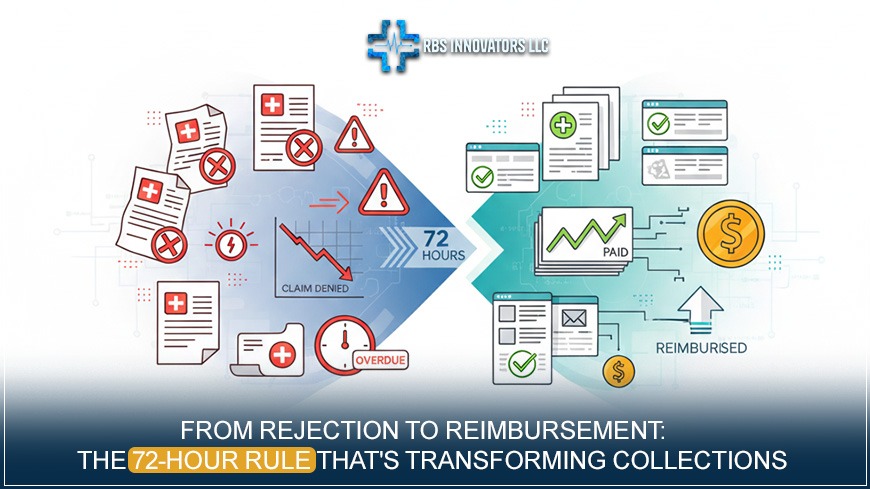
(The most effective revenue cycle strategy you’ve never heard of is the 72 Hours Rule.)
A medical practice that was drowning in denials came to us last month. Their time spent in A/R had increased to 67 days. They had a clean claim rate of less than 80%. Operations were being choked by cash flow.
“How quickly do you submit claims after seeing patients?” was the only question we posed.
The manager of the office paused. “Well, we batch them every week. It can take ten to fourteen days at times.
They were losing over $35,000 a month as a result of that delay, not from denials, but from claims that were getting older and more difficult to collect.
One modification was made: All clean claims must be submitted within 72 hours of service. Their clean claim rate reached 94% after sixty days. Days in A/R decreased to 38. The amount collected each month rose by 28%. same employees. same patients. One distinct habit. The most effective revenue cycle strategy you’ve never heard of is the 72-Hour Rule.
The 72 Hour Rule: What is it?
The 72 Hour Rule is quite straightforward. Within 72 hours of the date of service, code, charge, and submit each clean claim. Not for a week. Not when you “get to it.” Every claim should proceed from patient encounter to payer submission within three days.
This is more than just a nice-to-have best practice. According to industry standards, in order to maintain optimal revenue cycle performance, claims must be billed out within 72 hours and medical coding must be finished within 48 hours of the procedure. Why 72 hours? Because you lose money, your chances of a clean payment are decreased, and error rates rise with each day of delay.
The Unspoken Price of Postponing Filing a Claim
The majority of practices are unaware of the amount of money that is lost while claims are waiting to “get to them.”
The Issue of Memory Decay
Accurate documentation is essential for medical coding and billing. Crucial details become more difficult to recall the longer the time between service and coding.
Day 1 after service: The provider remembers every aspect of the interaction, including the patient’s presentation, the decision-making process, and the procedures carried out.
Day 7 after service: The provider finds it difficult to recall details without going over detailed notes.
Day 14 after service: More than 100 new patients have been seen by the provider. Details are hazy. There are gaps in the documentation.
The outcome? Money is lost due to incomplete charge capture, down coding to be “safe,” and missing modifiers.
The Effect of Error Multiplication
Errors build up in claims that are waiting in line like snowflakes in a storm. What begins as small gaps in documentation can develop into significant billing issues:
- Missing data is not discovered until it is submitted, which leads to rejections.
- Insurance modifications are not promptly detected (automatic denials)
- Unidentified authorization expirations (denied claims)
- Compounds with inaccurate patient information (clean-up nightmares)
There is a chance for something to go wrong every day that there is a delay.
The Compression of Cash Flow
Let’s calculate the reimbursement for a primary care practice that sees 100 patients every day at an average of $150 per visit:
Seven-Day Cycle of Billing:
- Fees per day: $15,000
- Day 7 is the first submission.
- Payer processing takes an average of 14–21 days.
- First payment: 21–28 days
- Cash flow deficit: almost a month
Billing Cycle of 72 Hours:
- Fees per day: $15,000
- Day 3 of the first submission
- 14–21 days for payer processing
- First payment: 17–24 days
- Gap in cash flow: about three weeks
Just filing claims on time will result in a 25–35% faster cash flow.
Annual impact: If you’re running on a 7-day cycle, you’ve got $105,000 to $150,000 just sitting in your pipeline at any moment. Switch to a 72-hour cycle and you drop that to $75,000 to $105,000. Suddenly, you’ve freed up $30,000 to $45,000 in working capital. That’s money you can actually use.
The Timely Filing Trap
Every payer sets a limit, usually somewhere between 90 and 365 days from the date of service. Miss that window, and your claim’s dead. No appeals, no second chances. Here’s what happens when you batch claims weekly or monthly:
- A claim waits around for 10 days before anyone even sends it.
- It gets kicked back for a tiny error.
- Then it sits another 7 days before someone notices the rejection.
- It takes 5 more days to fix and resubmit.
- Add that up, and you’ve already lost 22 days before the payer even looks at your claim.
If you’re stuck with a 90-day filing limit, you just burned through almost a quarter of your time without any real progress. On the other hand, practices on a 72-hour cycle? They spot mistakes early, fix them quickly, and always have a buffer if something goes wrong.
Why 72 Hours Really Matters
Why pick 72 hours instead of just one day or a whole week? Turns out, three days hits the sweet spot between moving fast and doing things right. Here’s how it breaks down.
Day1-2; Coding & Charge Entry
In the first two days after a procedure, coders get to work while everything’s still fresh in their minds. If anything seems off or confusing, there’s still time to reach out to providers and double-check details. Plus, there’s enough breathing room for a quick review and audit, so mistakes don’t slip through.
Try to cram everything into 24 hours, and you just end up with more errors. Wait longer than two days, and the details start to get fuzzy. Three days? That’s just right for getting accurate, reliable results without slowing everything down.
Day 3: Claim Scrubbing and Submission
This day gives you some breathing room to double-check everything before claims go out the door. Here’s what happens: You run automated claim scrubbing to catch mistakes. Someone reviews higher-dollar or trickier claims by hand, just to be sure. You make sure insurance info lines up. Then, you process and send claims electronically.
The Real Benchmark
Experts say 72 hours is reasonable sometimes, but honestly, the gold standard is getting it all done in 24 hours. Most practices land at 72 hours and can still keep their quality up, that’s the sweet spot for most folks. The top-performing teams hit this mark every time. The rest? They can take a week or even two. And honestly, the difference shows up fast in how much money gets collected.
The 72-Hour Rule in Action
Real Results
Case Study 1: Multi-Specialty Group Practice
Before they started using the 72-Hour Rule, things moved pretty slowly. They took about nine days after each service to send in claims. Only 78% of those claims went through cleanly the first time.
Money sat in accounts receivable for 58 days on average, and about 12% of claims got denied. Every month, the practice collected around $420,000.
Then they put the 72-Hour Rule in place. Suddenly, claims went out much faster, just 2.8 days after service. Their clean claim rate jumped to 93%. Money came in quicker, with days in A/R dropping to 36. Denials fell to just 5%. And monthly collections shot up to $547,000.
Bottom line, they pulled in $127,000 more every month, a 30% jump.
Case Study 2: Solo Practitioner (Internal Medicine)
Here’s the problem: One doctor, one part-time biller, and a slow routine, claims only went out once a week. That meant bills sat around for 10 to 14 days before reaching payers. So, they switched it up. Daily claim submissions, all within 72 hours. Automated coding and claim scrubbers handled the busywork.
After just three months, things looked a lot better. Days in A/R fell from 63 down to 41. Write-offs from missed filing deadlines dropped by 89%. Cash flow evened out, and the doctor didn’t need a line of credit anymore. Best part? The physician could actually focus on patients, not paperwork.
Case Study 3: Urgent Care Center
The place was swamped, over 150 patients a day, and claims just kept piling up. Submissions lagged behind by two to three weeks. So, they brought in another coder, started capturing charges in real time, and made sure every claim got submitted within 72 hours, no excuses.
Sixty days later, the backlog was gone. The clean claim rate jumped from 72% to 88%. Fewer denials meant they held onto $18,000 each month that used to slip through the cracks. And with collections coming in faster, cash flow shot up by 40%.
How to Actually Use the 72-Hour Rule in Your Practice
It’s one thing to know that bout the 72-hour rule takes some real changes. Here’s a simple, step-by-step way to get started.
Step 1: Figure Out Where You Stand (Week 1)
Before you do anything else, see how you’re doing right now.
Check How Fast You Submit Claims:
- Grab 50 random claims from last month.
- Look at the date of service and the date you sent each claim.
- Find the average number of days it took.
Spot the Hold-Ups:
- Where do claims slow down? Is it coding, charge entry, or the review process?
- Why do delays happen? Are you missing info, is the staff too busy, or is your tech slowing things down?
- Which types of claims always seem to drag?
Track Your Current Results:
- What’s your clean claim rate?
- How many days are claims sitting in A/R?
- What’s your denial rate?
- How many claims are more than 90 days old?
Once you know all this, you’re ready for the next step.
Step 2: Set Up Your Daily Workflow (Week 2-3)
Kick off your mornings
- by looking over all of yesterday’s encounters.
- Get every charge entered by noon, don’t let any slip by.
- If you find notes that are missing or incomplete, flag them right away.
Same Day Coding
- Hand things off to your coders that same day.
- They need to finish coding yesterday’s encounters before the day’s over.
- If something in the documentation doesn’t make sense, start a provider query immediately.
- Use your coding software to catch the easy mistakes early.
On Day 2, dive into a quality review and scrub those claims.
- Catch and fix any errors before they turn into rejections.
- While you’re at it, double-check insurance info and authorizations.
By Day 3, send out all the clean claims electronically.
- If anything still looks off, move those claims to the resolution queue and kick off your escalation process.
- Don’t let claims pile up, keep things moving.
Step 3: Roll Out Tech Support (Week 3-4)
Automated Eligibility Verification:
- Check insurance in real time when patients check in.
- Run automatic daily checks for everyone with an upcoming appointment.
- Get alerts if coverage changes or ends.
Claim Scrubbing Software:
- Clean up claims before sending them out.
- Catch coding mistakes, missing modifiers, or missing authorizations.
- Flag big-ticket claims so someone can double-check them.
Practice Management Integration:
- Move data smoothly from EHR to billing, no extra steps.
- Capture charges automatically from what’s documented during each visit.
- Get instant coding tips based on what’s in the notes.
Electronic Claim Submission:
- Send out batches of claims automatically every day.
- Get notified right away if a claim gets rejected.
- Post electronic remittance advice to accounts automatically.
Step 4: Train and Empower Your Team (Week 4-5)
Provider Education:
- Make sure everyone’s on the same page about documentation.
- Clear, detailed notes help speed up coding, so get those clinical notes done on time.
- If coding has questions, answer them fast, it keeps things moving.
Billing Staff Training:
- Everyone needs to know the 72-Hour Rule and how to handle it.
- Get comfortable with the new tech tools so work doesn’t slow down.
- If something goes wrong with a claim, follow the escalation steps right away.
Create Accountability:
- Keep an eye on how fast coders and billers submit their work.
- Set goals for the team and for each person.
- When things get better, acknowledge it.
- If delays keep happening, deal with them head-on.
Step 5: Keep an Eye on Things and Make Improvements (Always)
Check these dashboards every day:
- Claims waiting for coding, make sure they’re less than a day old.
- Claims waiting to be submitted, keep these under three days.
- How many claims you’re submitting each day.
- Real-time clean claim rate.
Every week, dig into performance:
- Average days it takes to submit claims.
- Trends in your clean claim rate.
- Where things get stuck.
- Why claims get denied, and how often.
Once a month, step back and look at the big picture:
- All the key revenue cycle numbers.
- How your accounts receivable is aging.
- If your collection rates are getting better.
- What kind of return you’re getting from the 72-Hour Rule.
Overcoming Common Implementation Challenges
“We Don’t Have Enough Staff.” Honestly, most of the time, you don’t need to hire more people, you just need smoother processes.
The 72-Hour Rule uncovers a lot of inefficiencies. Fix those, and suddenly your team isn’t as stretched as you thought. But let’s say you really are short-handed, Outsource coding when the volume gets high. Bring in tech to automate the boring, repetitive stuff.
Cross-train your team so people can cover for each other. Or look at RBS Innovators LLC, they might be able to take over your whole billing operation.
Our biggest roadblock with the 72-Hour Rule? Providers just aren’t finishing their notes on time.
Here’s what actually helps:
- Set clear policies about finishing notes, and make sure there are real consequences if someone falls behind.
- Give providers EHR templates that make documenting faster.
- Try voice-to-text tools, these save a ton of time.
- Don’t just talk about documentation; show providers how late notes hit our revenue.
- If someone keeps falling behind, pause their ability to schedule new patients until they’ve caught up.
Our Practice Management System is Just Too Slow
Technology shouldn’t be holding you back. If your system struggles to keep up with daily claim submissions, it’s time to take a hard look at your options. Ask yourself if your current setup really works for you. Maybe it’s time to move to a cloud-based solution that actually speeds things up.
You can also use add-on tools to fill the gaps your system leaves behind. Or, work with RBS Innovators LLC, they build their systems for speed, plain and simple.
We Get Too Many Rejections to Submit Claims This Fast
Honestly, submitting claims faster actually means you get fewer rejections. Here’s why:
- mistakes are easier to spot when the details are still fresh in your mind.
- Plus, insurance info stays up to date, so you’re not working with old data.
- Claim scrubbing tools can flag problems before you even hit submit.
And your staff? They’ll have enough time to fix any issues before those filing deadlines sneak up. If you’re seeing a lot of rejections, speed isn’t the issue, quality is. The 72-Hour Rule isn’t just about getting claims in fast; it pushes everyone to improve quality.
Don’t just hit submit and walk away.
Following up is just as important as sending the claim in the first place. Here’s how to stay on top of it:
- The 15-Day Rule If you’re filing claims electronically, don’t wait around.
- If you haven’t seen payment after 15 days, it’s time to check in.
- Some payers usually respond within 10 days, but still, follow up at the 15-day mark if you haven’t heard anything.
- For all unpaid claims, keep checking in at least every 28 days until you get paid.
Handling Denials:
- Move Fast Speed matters when you get a denial. Here’s what works:
- Acknowledge and log every denial within 24 hours, don’t let anything slip through the cracks.
- Within 48 hours, figure out why the claim got denied and what you need to fix.
In the next 72 hours,
- get your team together, review what happened, and update your templates or rules as needed.
- Fix and resubmit denied claims within five business days.
- Staying quick on denials keeps your recovery rates high and stops claims from aging out or missing deadlines.
Why RBS Innovators LLC Nails the 72-Hour Rule
At RBS Innovators LLC, the 72-Hour Rule isn’t just something we shoot for, it’s the backbone of how we work.
How Our Tech Gives You the Edge
Automated Claim Processing:
We lock in real-time charge capture that syncs straight with EHRs. AI jumps in to help with coding, so it’s faster and more precise. Our claim scrubbing catches almost every error before claims even go out, and electronic submission means claims get processed the same day.
Smarter Workflows:
Dashboards flag any claim that’s getting close to the 72-hour mark. If a claim stalls, it’s automatically bumped up the priority list. We can watch performance in real time, broken down by claim, coder, or even by practice.
Why Our Process Just Works Daily Submission
No Excuses: Every day, we review and submit claims from each practice. Claims never sit around longer than 72 hours, unless we’re waiting on the provider. Our teams tackle claims as they come in, not in big, slow batches.
We Solve Problems Before They Slow You Down: If something’s missing, we spot it fast and reach out to providers that same day. We catch insurance verification issues before they turn into denials. And we always track prior authorizations, so nothing falls through the cracks.
What we deliver for RBS Innovators LLC clients:
We keep our clean claim rate above 95%.
- When a service wraps up, we get claims submitted fast, usually in just over two days.
- On average, claims sit in accounts receivable for 32 to 38 days.
- Compare that to the usual industry wait of 45 to 55 days. Our denial rate stays low too, just 3 to 5%, while the industry average sits much higher, around 10 to 15%.
We’re pushing hard to get that even lower, aiming for the gold standard of 1 to 2 percent.
Also Read: How to Choose the Right Credentialing Service for Your Practice
The RBS Innovators Difference
- We’re not just quick, we know what we’re doing.
- Our coders get your specialty. They don’t just move fast; they get it right.
- We’ve built payer rules right into our system, so you don’t lose time (or money) on preventable mistakes.
- And we never stop improving.
- We track denials, figure out why they happen, and update our process.
The tech learns your practice, so it actually gets better the longer you work with us. Total transparency, no hiding the ball. You can see your claims moving in real time on our dashboard. Want numbers? You get daily reports on submissions, and every month we sit down and walk through your revenue cycle with you.
Our Guarantee
- If you ever have questions, your own account team is just a call or email away.
- We promise to submit at least 95% of your claims within 72 hours.
- We guarantee clean claims and set real goals to shrink your days in A/R.
If we miss the mark, you don’t pay us until we make it right. Simple as that.
Act Now: Claim Your Free 72-Hour Rule Assessment
If your practice is dealing with slow collections and old A/R, RBS Innovators LLC is offering a handful of free 72-Hour Rule assessments. Here’s what you get:
- We will review how quickly you’re submitting claims.
- Pinpoint exactly where things are getting stuck in your revenue cycle.
- Show you what those delays are really costing you, most people are surprised.
- You’ll get a step-by-step plan tailored for you, so you can hit that 72-hour submission mark.
- We’ll even break down how much more you could be collecting with these changes.
Here’s how it works:
1. Book your assessment (a quick 30-minute call).
2. Send over 30 days of your claims data so we can dig in.
3. Get a detailed report from us within five business days.
4. We’ll walk through the results together, no pressure, just real talk.
5. From there, you choose: handle the changes yourself, or team up with us. No strings attached.
No pushy sales. Just real answers and a clear path forward. Reach out to RBS Innovators LLC to get started.