
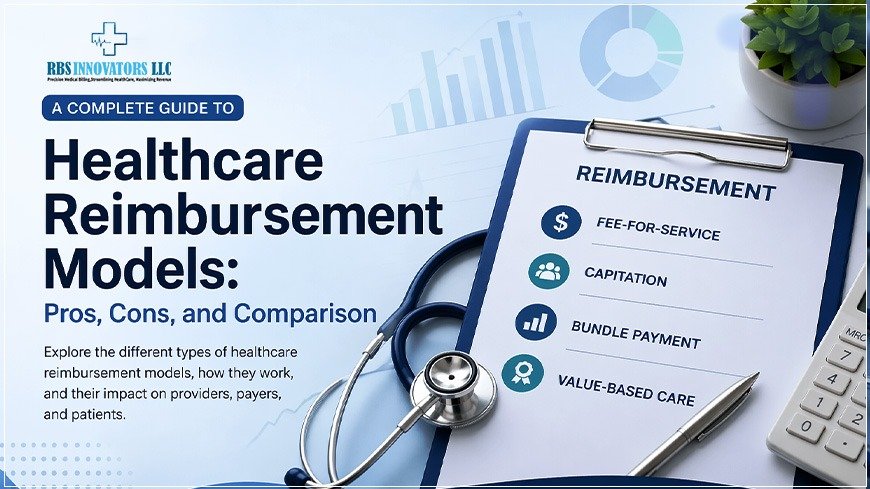
Behind all medical procedures, tests, and hospitalizations, there is one unspoken yet crucial question: who pays, how much, and why? The answer is healthcare reimbursement models. In simple words, it’s all about the payment structure in healthcare, which determines how care is delivered, priced, and rewarded.
It is the payment model used by the healthcare facility involved, whether a flat monthly payment, per-service payment, or lump sum payment for surgery. Whatever type you choose, it will directly impact the clinic’s profitability and patient outcomes.
The old paradigm of healthcare was simple: The more services provided, the more money received. This philosophy is quickly becoming obsolete. The new approach to reimbursement encourages pay-for-performance, focusing more on quality than quantity.
However, with so many possibilities, how will you choose the right model for you? This blog provides a comprehensive overview of the five most popular healthcare reimbursement models, detailing the advantages and disadvantages of each.
What are Healthcare Reimbursement Models?
Reimbursement involves compensation received by a health care provider for providing medical services. A healthcare reimbursement model is simply the system that determines how and how much doctors, hospitals, and other providers get paid for the care they deliver.
It can be defined as the payment rules between three parties: patients, providers, and payers (Medicare, Medicaid, or private insurance companies). Healthcare reimbursement models are agreement that decides:
- Who is paid (hospitals, physicians, health care centers)
- How much they receive (flat rate, unit price, cost per member)
- When payment occurs (prepayment, post-payment, results-based)
- What prompts payment (visit, treatment, population healthiness)
The following are the most common 5 healthcare reimbursement models:
Global Reimbursement Model

The Global Reimbursement model involves one check for everything: staff salaries, equipment, facility costs, and everything else you need to take care of the patients.
In the Global Reimbursement model, a healthcare facility will be allocated a fixed amount to fund operations, no matter how many patients they see. Whether they treat 100 patients or 10,000, the payment stays the same.
For example, a patient who is diagnosed with coronary artery disease undergoes the entire episode of care, including consultations with the cardiologist, tests before surgery, surgery, intensive care unit (ICU) stay, and three months of cardiac rehabilitation. In this case, the cardiologist will be reimbursed based on the global code for cardiac surgery because he will be paid based on the total episode of care.
Pros
- Decreased administrative workload.
- The provider knows precisely how much money they will receive, which simplifies budgeting and planning processes.
- With no uncertainty about costs, providers have an incentive to maintain the patient’s health and prevent costly emergencies.
- No additional income from excessive tests and consultations encourages responsible healthcare practices.
Cons
- The fixed budget may prove insufficient to meet patient demands (in case of an epidemic or difficult patient cases).
- On very rare occasions, there may be a temptation to cut down services due to budgetary constraints
- Its successful implementation relies on the effectiveness of risk adjustment and other forecasting tools.
- It is difficult to implement new procedures and technology advancements without budget revisions.
Suitable For
Appropriate for large regional healthcare organizations and government schemes that handle the healthcare of a complete population.
Cost-Based Reimbursement Model
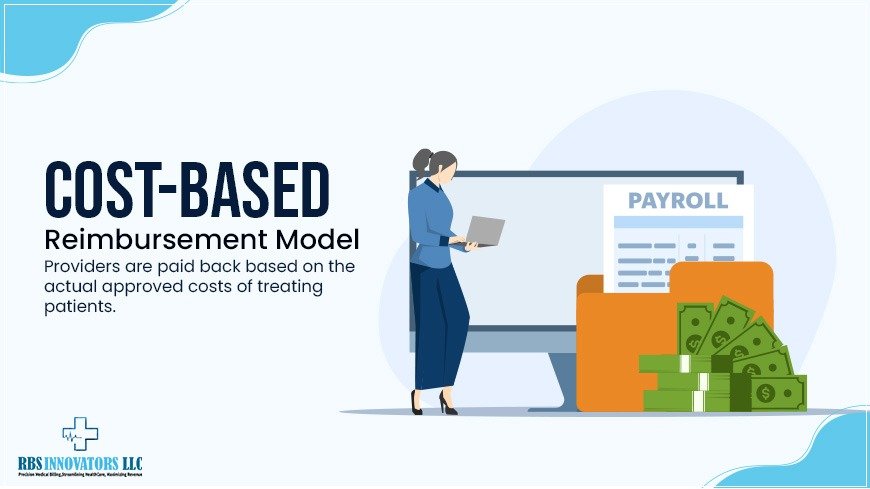
Cost-Based Reimbursement is the payment system used by the Medicaid program for some medical facilities, where payments are based on the actual costs of treating Medicaid patients. The facility reports its costs when providing medical services, and then Medicaid makes an audit of these data and decides on the amount of reimbursement.
However, not all costs will be reimbursed. Only costs approved by the Medicaid program and related directly to the provision of medical services will be reimbursed.
Consider the same scenario of serious coronary artery disease that undergoes all phases of care. Here, the hospital will bill the exact amount spent on all these processes, which includes personnel and other expenditures involved in the entire process.
Pros
- As all expenses are paid for, there is no risk for the facility in treating unusual or complicated cases.
- Small-town hospitals, specialized medical institutions, and emergency departments will be able to operate efficiently regardless of their population or profit margins.
- Each cent spent is accounted for, making it simpler for regulatory authorities to monitor expenses.
- Charities and publicly-owned facilities can concentrate on providing healthcare without having to calculate the cost-effectiveness of each procedure.
Cons
- The more money spent, the more you earn, which can unintentionally encourage waste or inflated costs.
- In the absence of financial pressure to control costs, there is no check against inflation.
- The healthcare provider has to account for all expenses accurately, which is a time-consuming process.
- There is greater motivation to treat disease than to prevent it.
Suitable For
Appropriate for rural hospitals, critical-access hospitals, and safety-net healthcare providers with limited resources.
Fee-for-Service (FFS) Reimbursement Model
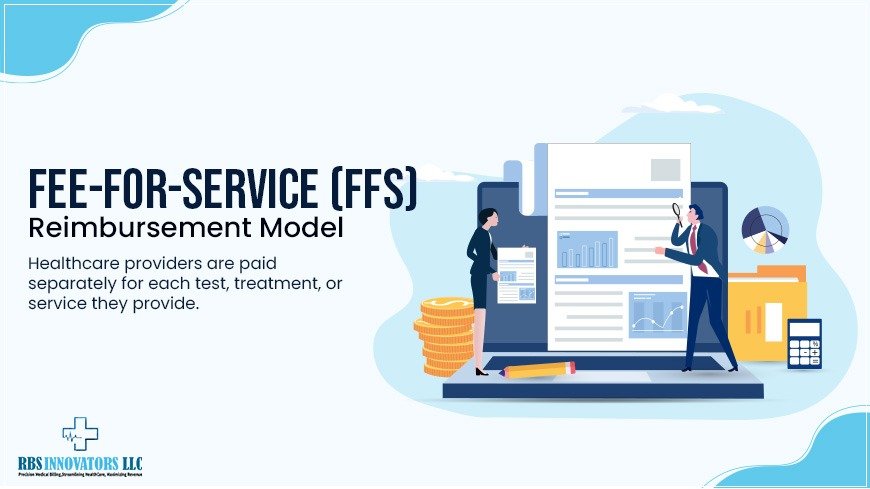
In FFS, payment is provided based on the number of separate services provided by the provider; an office visit, lab work, X-rays, surgery, etc. The more services offered, the more payment received.
Imagine a menu at a local restaurant. Each item has a cost, and the total payment is the sum of all items ordered. This is how fee-for-service billing works, and it has not changed for decades.
In the case of Free For Service, the provider uses unique codes for every single service provided, whether it’s an examination, laboratory analysis, or therapy session, and gets paid accordingly for every single procedure. The number of services provided determines the amount of payment, which means that volume is key to profitability.
Pros
- Clearly priced services are easy to bill and audit, as well as communicate to patients.
- Clinicians can treat more patients and provide more services because there are no payment limits.
- Suitable for specialty areas with unpredictable or highly variable service demands (emergency medicine, surgery).
- Any new test, technology, or procedure can be charged easily without negotiating package rates.
Cons
- More tests, procedures, and visits mean higher income, resulting in overtreatment and fragmented care.
- The United States spends more per capita than any other country; FFS is the main cause.
- Physicians are paid for sickness, not wellness, since their reimbursement comes when people are sick.
- While relatively straightforward on an individual level, managing tens of thousands of codes is very complex.
Suitable For
Appropriate for specialist clinics, diagnostic clinics, and stand-alone healthcare providers who provide a specific service.
Capitation Reimbursement Model

In the Capitation approach, a physician receives a fixed fee per patient per month (PMPM) to provide a certain range of services. No matter how many visits the patient makes during the month, the provider receives a fixed fee.
All your bills for healthcare are fixed, and you don’t have to pay anything for each visit. It is exactly how the Capitation system operates.
For instance, a Type 2 diabetic patient enters a primary care practice with a capitation contract. The practice is immediately paid the same fee each month for each patient that is enrolled, whether this particular patient visits the clinic once a year or once a day. The year passes, and during that period, the patient is seen for blood tests, prescription refills, dietary advice, and foot checks. In the Capitation Reimbursement model, there is a fixed amount for everything.
Pros
- It is possible for providers to predict their income and organize their resources before the claims processing cycle.
- The costs being known, it is in the financial interest of providers to prevent unnecessary ER visits.
- No extra incentive for conducting duplicate tests or unnecessary follow-up visits.
- The providers will be encouraged to coordinate the various types of care to avoid any gaps or overlaps.
Cons
- If the patients who are enrolled prove to have higher health needs than anticipated, the payments could be inadequate to cover the expenses.
- Very occasionally, there might be a tendency towards delaying referrals and restricting treatment.
- Determining appropriate PMPMs is a complex task that needs very precise calculations.
Suitable For
Best for general practices, managed-care schemes, and accountable care organizations whose relationship with patients is enduring.
Bundled Reimbursement Model
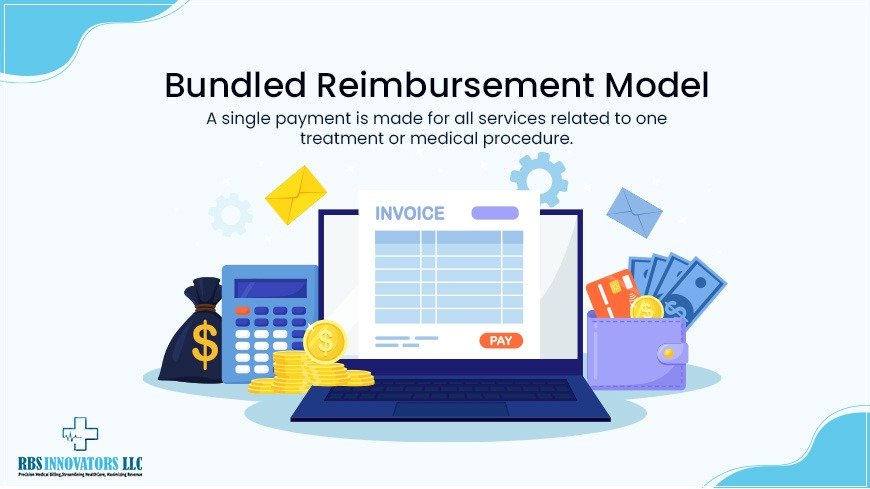
In a bundled reimbursement model, all the providers involved in treating a patient receive only one pre-negotiated fee for all their services, for the specified diagnosis, procedure, or care encounter.
For example, hip joint replacement can include fees such as the orthopedic surgeon’s fee, anesthesia charges, hospitalization costs, physical therapy, and follow-up treatment in 90 days, all in one fee. That’s Bundled Reimbursement at work in medicine.
Pros
- All the providers within the episode have one aim in common: to provide efficient and effective services while minimizing errors.
- This model helps in ensuring that there is no duplication of services or readmission because everybody gets compensated in a single payment.
- Predictability of cost in advance saves from any shocks in terms of higher costs and helps in managing budgets.
- The surgeons, hospitals, and primary care providers have to coordinate their efforts within the care episode.
Cons
- Determining the parameters of the episode, setting reasonable prices, and allocating funds among various providers will require complex contracting and information exchange.
- Providers may differ on who bears the risk for complications or any potential costs that go beyond the budget.
- Effective implementation will hinge on the use of interoperable EHRs, data tracking systems, and open cost accounting.
- Effective only for certain episodic treatments (such as knee or hip replacement), not suited to more complicated cases.
Suitable For
Appropriate for surgical clinics, orthopedic clinics, and hospitals involved with the management of a particular healthcare episode.
Comparison of Healthcare Reimbursement Models
No single model is universally optimal; most modern systems use hybrid or value-based approaches. The Following is the comparison of models:
| Models | Payment Basis | Financial Risk | Primary Incentive | Ideal For |
| Global | Fixed budget | Provider or System | Cost containment and population health | Integrated systems, public programs |
| Cost based | Actual cost and margin | Payer or Government | Facility sustainability | Rural or specialty hospitals |
| Fee-for-Service | Per service or procedure | Payer | Volume and productivity | Specialty clinics, traditional insurance |
| Capitation | PMPM fixed rate | Provider | Preventive care and efficiency | Primary care, HMOs, ACOs |
| Bundled | Per condition | Shared | Care coordination and outcomes | Surgical pathways, maternity, cardiac |
Frequently Asked Questions (FAQs)
Q1: Which model is commonly used in healthcare?
Ans. Fee-for-Service (FFS) is the most common reimbursement model, especially in the United States, though many systems are increasingly adopting hybrid or value-based approaches.
Q2: Are value-based models taking the place of the traditional reimbursement system?
Ans. Yes, value-based systems are increasingly common as payers shift their focus from quantity to quality.
Q3: Which type of reimbursement model should I adopt within my organization?
Ans. Choice of model based on your patient demographics, the level of care your institution can provide, and its technological capacity, and then implement an appropriate model.
Conclusion
There is no perfect model that can be applied in all cases regarding health care financing. The best companies do not choose one; they integrate different models, match the payment systems with quality goals, and develop information resources in order to move from fee-for-service to a value-based payment system. Learning about these models goes far beyond basic knowledge of finances. It is a foundation for sustainable, patient-centered care.