
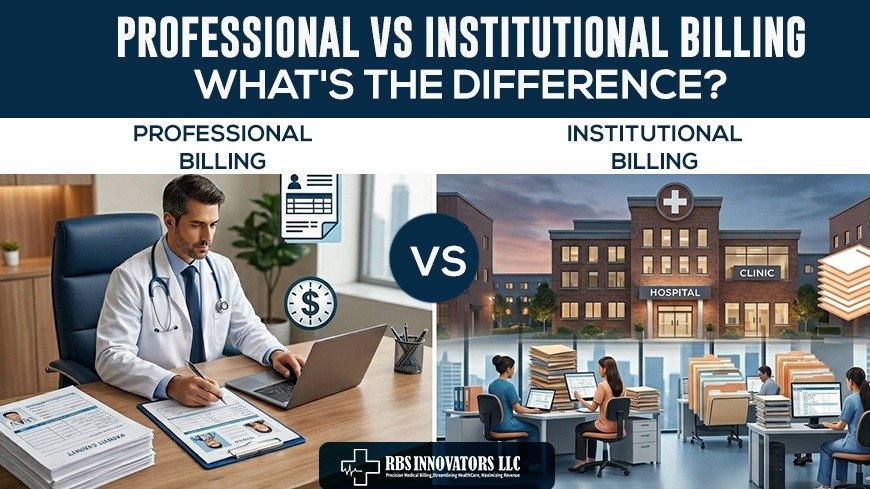
Mistakes cannot happen when someone’s health hangs in the balance. Yet, oddly enough, clinics often overlook how closely accuracy is tied to cash flow. A frequent cause of rejected claims and delayed payments is the confusion between professional billing and institutional billing; it trips up even experienced offices.
Picture yourself managing a clinic and feeling unsure about billing terms. Or perhaps you’re a clinician double-checking forms before submission. Mixing up these details can cost both time and money. This blog clears the confusion without unnecessary complexity. It contains the detailed professional vs institutional billing, and it also compares the CMS-1500 and UB-04, not just by name, but by how they function in practice. Real-world examples clearly show where each form applies.
Understanding the distinction between professional and facility-based claims helps prevent delays.
What is Professional Billing?
Fundamentally, professional billing entails a process whereby claims are filed for services provided by individual healthcare providers, such as physicians, surgeons, nurse practitioners, physician assistants, and other licensed healthcare providers. This process has also been termed the “provider side” of medical billing, primarily due to its focus on professional expertise, time, and skill provided by healthcare providers.
Who Submits Professional Claims?
Typically, professional claims are submitted by:
- Individual practitioners, i.e., solo practice.
- Physician groups or multi-specialty clinics.
- Independent contractors providing services in a facility.
- Telehealth services, i.e., claims billed for virtual consultations
Healthcare workers get a special ID number called a Type 1 NPI. This unique code tags each person practicing medicine. Claims go through using that specific identifier linked to them.
What Services Does Professional Billing Cover?
Professional billing refers to the evaluation, diagnosis, and treatment services provided directly by the physician. Here are some common examples:
- Office visit: It includes E/M codes that are used for patient consultations and follow-ups.
- Surgical Procedures: It involves surgical processes such as vascular surgeons performing endovascular repair or carotid stenting.
- Interpretive Services: The reading and interpretation of tests such as ultrasounds, MRIs, or angiograms.
- Care Management: Chronic care management (CCM) or Transitional Care Management (TCM).
For instance, when a vascular surgeon performs a procedure in the hospital outpatient department, two separate bills will be created. The vascular surgeon will file one claim for their professional service, while the hospital will file a claim for the facility services used in the procedure.
The Professional Claim Form: CMS-1500
The CMS-1500 form is used to submit all professional claims, and it is recognized by Medicare, Medicaid, and most commercial payers.
Here are examples of a professional claim form:
| Field | Purpose | Importance |
| Box 24D | Procedure Code (CPT/HCPCS) | Identifies the service performed. |
| Box 24B | Place of Service (POS) Code | Where the service is performed. |
| Box 24J | Rendering Provider NPI | Links the service to the individual provider. |
| Box 33 | Billing Provider Info | Contains the group practice or billing service details. |
Importance of Place of Service (POS)
Place of Service codes for professional billing services use two-digit codes to describe the place of service. These codes are not insignificant. They actually affect the reimbursement. For example:
- POS 11 – Office: This usually has a higher reimbursement rate because it covers the overhead of the private practice.
- POS 22 – Outpatient Hospital: This may affect the facility fee adjustment.
- POS 24 – Ambulatory Surgical Center: Modifiers must be added to the claim to ensure the correct bundling of the facility claim.
Incorrect coding of the place of service is one of the top reasons for underpayment or audit. Always confirm the location code matches the actual place of service documented in the patient’s chart.
What is Institutional Billing?
Instead of focusing on individual providers like doctors, it handles charges tied to the physical place where care happens, i.e., hospital rooms, medical equipment, and round-the-clock staffing. Places such as surgery centers, long-term care homes, and clinics you visit without staying overnight – all fall under this type.
Even mobile therapy teams or nurses visiting someone at home count here. It tracks everything needed behind the scenes so that treatment can occur effectively.
Who Submits Institutional Claims?
It is submitted by the facility or the organization that provided the care to the patients:
- Hospitals (inpatient and outpatient departments)
- Ambulatory Surgical Centers (ASCs)
- Skilled Nursing Facilities (SNFs)
- Home Health Agencies
- Hospice organizations
- Independent diagnostic testing facilities (IDTFs)
These claims are submitted using the facility’s Type 2 National Provider Identifier (NPI), which is allocated to organizations and group practices.
What Services Does Institutional Billing Cover?
Institutional billing can include the facility fee, which is defined as the costs necessary to maintain a safe, equipped, and staffed environment for patient care. This can include:
- Room and Board: This is for inpatient hospitalization or observation.
- Operating Room: It is for the use of MRI machines, sterilization, and other surgical supplies.
- Nursing and Support Staff: This is for the salaries of RNs, techs, and other support personnel.
- Diagnostic Equipment: For use with MRI machines, catheterization labs, etc.
- Pharmacy and Supplies: This is for medication dispensed on site, dressings, catheters, implants, etc.
For instance, when a patient has surgery to bypass a limb, the hospital makes an institutional claim for operating room time, nursing care, and surgical supplies. Meanwhile, the vascular surgeon makes a professional claim to his skill and expertise. The claim is both necessary and legitimate, but it is made separately.
The Institutional Claim Form: UB-04 (CMS-1450)
All claims are submitted using the UB-04 form (also known as the CMS-1450) or its electronic version, the 837I file. This form is much more complex than the CMS-1500 and reflects the multifaceted nature of facility services.
| Field | Purpose | Importance |
| FL 4 | Type of Bill (TOB) Code | Indicate the billing facility and the type of service period covered. |
| FL 42-49 | Revenue and procedural Codes. | Categorize charges by department. |
| FL 50 | Payer Name. | Medicare, Medicaid, BCBS, etc. |
| FL 56 | Attending Provider NPI. | Links the facility claim to the treating physician. |
| FL 67 | Principal diagnosis Code. | The ICD-10-CM code is primarily responsible for services. |
Understanding Type of Bill (TOB) Codes
The type of bill codes for institutional billing is the foundation of facility claims. This three-digit code is crucial in providing the following information:
- First Digit: This identifies the type of facility: Hospital, SNF, ASC, Rehabilitation Hospital, Rehabilitation Unit in Hospital, Hospice, Nursing Facility, etc.
- Second Digit: This identifies the classification of care: Inpatient, Swing Bed, Outpatient, etc.
- Third Digit: This identifies the sequence/frequency of the claim: Admit to discharge, Interim – first claim, etc.
Form CMS-1500 vs. UB-04
When we take into account professional vs. institutional billing, it depends entirely on the billing form that we use, such as the CMS-1500 vs. the UB-04 form.
| Feature | Form CMS-1500 | Form UB-04 |
| Claim Type | Professional. | Institutional. |
| Billed by | Provider (Type 1 NPI). | Facility (Type 2 NPI). |
| Key Codes | CPT/HCPCS + POS Codes. | Revenue Codes + TOB Codes. |
| Complexity | Optimized for services. | Detailed for resources. |
Billing CMS-1500 for institutional results in automatic denials and vice versa. Always use the appropriate form that matches the type of services provided for timely reimbursement.
Coding Differences: POS vs. TOB
Correcting the codes is the difference between a clear claim and a costly denial. Below is a quick look at the two most important coding systems for professional vs institutional billing.
| Feature | POS Codes (Professional) | TOB Codes (Institutional) |
| Length | 2 digits | 3 digits |
| Answer | Where was the service performed? | Type of facility and care setting. |
| Used On | CMS-1500 / 837P | UB-04 / 837I |
| Impact | It adjusts the provider payment rate. | It determines facility reimbursement methodology. |
Common Mistakes and How to Avoid Denials
Even a minor mistake in professional and institutional billing may result in a denial of the claim. These are the major mistakes you should avoid.
Use incorrect form
Billing UB-04 for professional billing results in denial. Carefully match the form to the billing facility to avoid denial.
Misleading Place of Service (POS) or Type of Bill (TOB) Codes
Using POS 11 (Office) for a hospital-based service, or TOB 111 (Inpatient) for an outpatient procedure, also results in claim rejection.
To avoid this, check the proper location and patient status from the record. Compare place-of-service codes with professional charge information and type-of-bill codes with institutional charge information using payer criteria.
Incorrect NPIs
Incorrect usage of NPI leads to rejection. Always double-check the NPI type.
Incomplete Revenue or Procedure Coding
Not assigning codes for revenues on the UB-04 form or not associating CPT codes with the proper revenue centers are common mistakes. To avoid this, make sure each charge line on institutional claims carries revenue codes. On professional claims, combine the CPT codes with the proper modifiers and place of service (POS) codes.
Frequently Asked Questions (FAQs)
Q1: Can a provider submit both professional and institutional claims?
Ans. Yes, providers can submit both if they offer both clinical and facility services.
Q2: What is the electronic equivalent of the CMS-1500?
Ans. The 837P (Professional) is the electronic version of the CMS-1500.
Q3: Why is the NPI (National Provider Identifier) important in a claim?
Ans. NPI is a unique 10-digit identifier assigned to a health care provider for use in a standard HIPAA transaction.
Conclusion
Professional and institutional billing is necessary for the preservation of your practice’s finances and for maintaining compliance. Whether understanding the difference between professional and institutional billing, when to use the CMS-1500 vs UB-04 forms, determining the correct place of service codes for professional billing, or the type of bill codes for institutional billing, all are critical elements.
If understanding these complexities seems overwhelming, you don’t have to do it alone. Our expert billing services for every claim, whether it is professional or institutional, are submitted with pinpoint accuracy.