

In medical practice, it’s important to provide excellent patient care, but somewhere between treatment and payment, your hard-earned money is lost. A pile of missed charge entries, rejected claims, and denials silently eats away your revenue.
This is actually a sign of poor revenue cycle management (RCM). But this loss can be prevented. If your RCM services are in place, handling everything from insurance verification to claims submission, resolution of denied bills, and payment posting, your organization can save every penny it’s entitled to.
In this guide, we will talk about the most common revenue leaks and how professional RCM services fix them.
What is Revenue Cycle Management?
Revenue Cycle Management (RCM) is the financial backbone of your medical practice. It is a complete process of managing every financial transaction from booking a patient’s appointment to the full collection of their dues.
This is how the Revenue Cycle Management Process works:
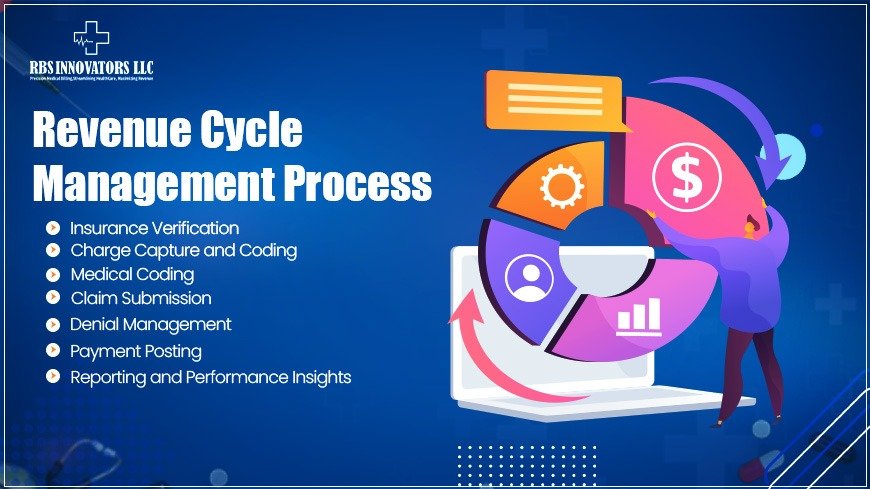
Insurance Verification
Checking whether the patient’s insurance is valid or not.
Charge Capture and Coding
Keeping accurate records of medical services provided.
Medical Coding
Converting treatments into specific medical codes.
Claim Submission
It involves submitting a bill to the insurance company for payment.
Denial Management
Correcting and resubmitting denied claims.
Payment Posting
Post the amount received to the accounting system.
Reporting and Performance Insights
Get real-time KPI reports to improve revenue cycle and cash flow.
If you complete all the above steps effectively, then your business will grow. However, if there is a problem with even a single step, the whole process will slow down, causing your earnings to drop.
The Most Common Revenue Leaks
Here are five common mistakes that are silently killing your revenue:
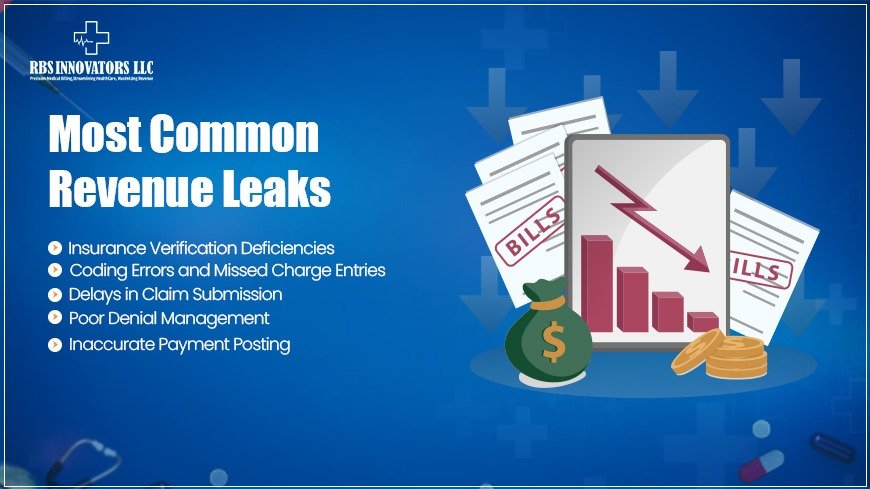
Insurance Verification Deficiencies
When insurance verification is rushed or completely ignored before a patient is treated, claims are filed based on incorrect information. This results in claim denials and delayed payments, which could have been prevented with just a pre-screening check.
Coding Errors and Missed Charge Entries
Undercoding, overcoding, or forgetting to enter charges for a procedure can kill profits. Even one missed code per day can add up to a significant financial loss at the end of the year, which is often difficult to track.
Delays in Claim Submission
The days a clean claim is not filed are the days your cash flow is stalled. Slow claim processing unnecessarily lengthens payment periods, and accounts become outdated.
Poor Denial Management
Claims that are denied and not appealed become a permanent loss of revenue. Without a formal workflow for resolving claims denials, organizations often miss out on payments that could have been obtained through timely appeals.
Inaccurate Payment Posting
Inaccurate payment posting can ruin your entire A/R picture. When payments are posted incorrectly, underpayments go undetected, amounts owed go uncollected, and your financial reports become unsatisfactory.
How do strong RCM Services Prevent Every Loss?
It’s not enough to just know where money is being wasted, but closing those holes is the real success. Professional RCM services protect your hard-earned money by fixing the problems in your system.
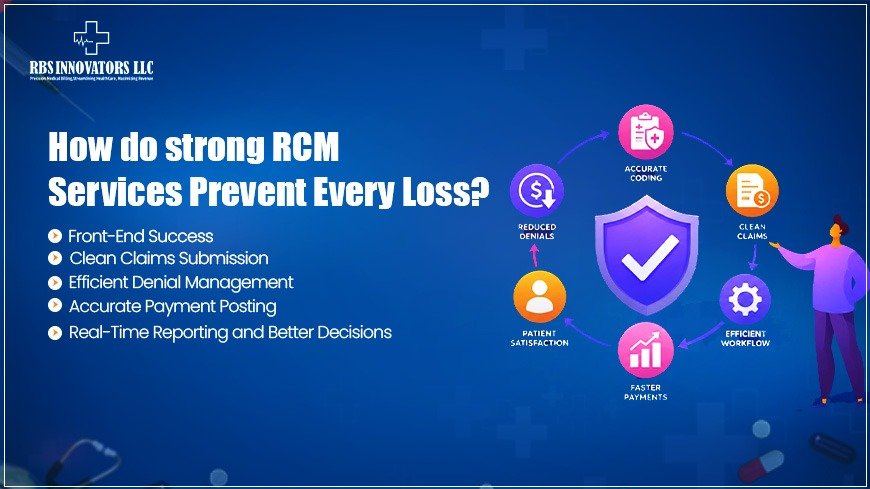
Front-End Success
A patient’s insurance is checked 24 to 48 hours before their visit. This shows whether the insurance is active, how much the patient will have to pay (co-pay), and whether prior authorization is required for the treatment. This one step prevents most claims from rejection.
Clean Claims Submission
Claims are thoroughly scrubbed before they are sent. The advantage of this is that insurance companies approve claims quickly, and payments are received faster.
Efficient Denial Management
If a claim is denied, it is not just dropped, but the reason is identified and appealed within a timely manner. This not only recovers the money that was withheld, but also prevents the same mistake from happening again in the future.
Accurate Payment Posting
Every amount received is posted to the correct patient account. This helps you know your true financial status, identifies underpayments, and keeps your reports reliable.
Real-Time Reporting and Better Decisions
A good RCM model gives you statistics like the average time it takes to get a refund and the percentage of initial claim approvals. With that kind of data at hand, you can make better choices that will increase the profitability of your organization.
Signs Your Practice Needs Professional RCM Services
If you are seeing any of the following signs in your practice, it means you need professional RCM services:
- If the average time to collect your accounts receivable consistently exceeds 40 days.
- If the claim denial rate is more than 5 to 7 percent, and there is no formal process for appealing them.
- If insurance verification is done on the same day the patient comes in, or is skipped altogether.
- If payment posting is delayed by more than 24 to 48 hours.
- You may not know which insurance companies are holding back the most payments or denying claims.
- Your billing staff is spending more time fixing old and rejected bills than sending out new and accurate claims.
- Patient numbers are growing, but your revenue (income) is stagnant.
If two or more of these things apply to your practice, it means your revenue is being lost through, and you need an efficient RCM system.
In-House vs. Outsourced RCM
The decision of what is best for you, in-house vs. outsourced RCM, depends on your practice’s needs.
In-House RCM
In-House RCM is best suited for larger health systems that have dedicated billing departments, advanced technology, and trained staff.
Outsourced RCM
In contrast, outsourced RCM services work best for small and medium-sized practices that don’t have the time to meticulously manage the entire billing cycle. Outsourcing turns your fixed costs into a performance-based partnership, where your partner only succeeds when you get paid.
Choosing the most appropriate solution requires consideration of the size of your business, the type of work, and denial rates.
Frequently Asked Questions(FAQs)
Q1: Name the three pillars of revenue cycle management?
Ans. The three pillars of revenue cycle are people, process, and technology that work together to make sure correct billing, claim submission on time, and maximum revenue collection.
Q2: What is an RCM audit?
Ans. RCM audit involves a detailed examination of a practice’s entire billing and collection process in order to identify revenue leakage, areas where the practice falls short in terms of compliance, and how to optimize its finances.
Q3: What are some common RCM challenges?
Ans. Common RCM challenges are invalid patient information, incomplete insurance verification, coding errors, slow payment posting, poor denial management, and delayed claim submission.
Conclusion
Revenue Leaks are the things that accumulate silently until the damage is done. But through a systematic Revenue Cycle Management (RCM) process, each step in your billing cycle becomes a checkpoint that protects your profits instead of letting them go. The right RCM services can transform your organization’s financial performance. Your income is not a game of luck, but it is the result of a perfect process.