
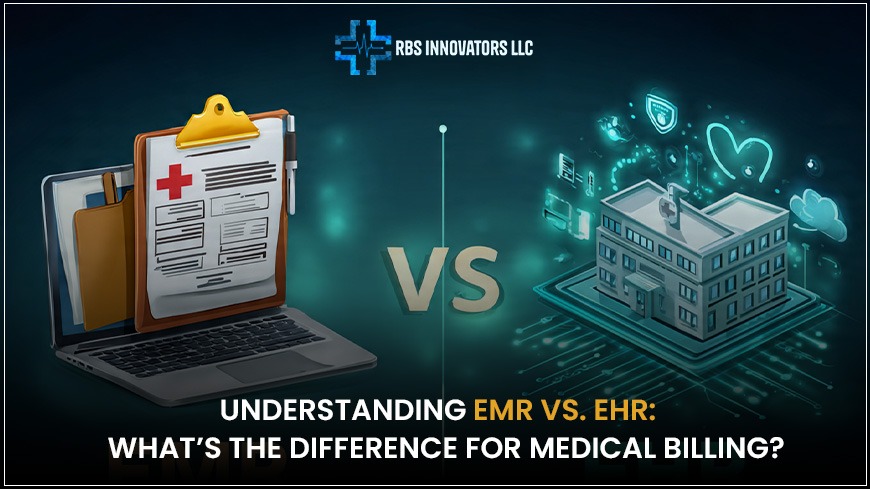
Quick Answer
EHR (Electronic Health Record) exchanges patient data with various providers and systems. However, EMR (Electronic Medical Record) keeps patient data within a single healthcare practice. By offering more extensive, interoperable data access, EHRs in medical billing smooth claim submissions and increase revenue cycle accuracy.
An Overview
Technology increases the efficiency in the current healthcare environment. And nowhere is this more apparent than in medical billing. Although they have different functions, two essential digital tools, EMR and EHR, are frequently used interchangeably. Comprehending their distinctions is essential for precise coding, billing, and compliance.
Let’s examine the differences between EMR and EHR and how they affect your medical billing process.
The Electronic Medical Record (EMR): What Is It?
Within a single healthcare facility, an electronic medical record (EMR) is a digital representation of a patient’s chart. It includes clinical data like:
- Demographics of patients
- Medical and treatment history
- Prescriptions and diagnosis
- Dates of immunization and test findings
EMRs, however, are not made to share data with practices outside of their own. This implies that a patient’s EMR information usually does not transfer when they change doctors.
The Effects of EMR on Medical Billing
- facilitates internal billing procedures
- keeps track of patient visits and procedures in order to capture charges.
- permits the preparation of claims internally.
- has restricted interoperability, which may limit the ability to coordinate insurance.
Small clinics or single-specialty practices that manage billing within the same system are the ideal candidates for EMR.
What is an electronic health record, or EHR?
An EHR is not limited to a single clinic. It offers a thorough, transferable record that several medical professionals can safely access. Because EHRs are designed to be interoperable, information can be shared between billing systems, labs, pharmacies, and hospitals.
All of the components of an EMR are included in an EHR, plus more:
- Imaging and laboratory results
- Insurance information and past claims
- Clinical notes from multiple specialties
- Multiple providers’ real-time updates
The Benefits of EHR for Medical Billing
- simplifies the submission of claims with comprehensive, validated information.
- reduces denials and coding errors by using automated data collection
- guarantees quicker reimbursements and payer compliance.
- enhances communication between billing teams and providers
EHR systems drastically cut down on administrative errors and revenue cycle delays for larger practices or multispecialty networks.
EMR vs EHR: Key Differences at a Glance
| Feature | EMR | EHR |
|---|---|---|
| Scope | Single practice | Multiple providers |
| Data Sharing | Limited | Interoperable |
| Medical Billing Integration | Basic | Advanced |
| Patient Access | Practice-specific | Accessible across systems |
| Compliance Support | Internal only | Supports MIPS, HIPAA, etc. |
| Best For | Small clinics | Large practices & hospitals |
Why Medical Billing Is Affected by the Difference
Financial success in medical billing is determined by efficiency and accuracy. Data inconsistencies, claim denials, and compliance issues can result from using the incorrect system.
- Accuracy of Claims
EHRs reduce human entry errors in CPT and ICD-10 coding by obtaining data directly from validated sources.
- Quicker Payments
EHRs facilitate faster claim adjudication and real-time eligibility checks by establishing direct connections with payer systems.
- Improved Adherence
EHR systems ensure secure data handling during billing by assisting practices in maintaining compliance with CMS and HIPAA regulations.
- Analytics for Performance
Most EMRs lack the billing analytics dashboards that advanced EHRs provide. These dashboards help in tracking payer performance, revenue cycles, and AR trends.
Which System Is Best for Your Practice?
Your practice’s size and workflow objectives will determine which option is best for you:
- If you’re a small or solo practice that prefers simplicity and handles billing internally, go with EMR.
- If your practice has remote billing teams, multiple providers, or third-party billing companies that require real-time access to data, go with an EHR.
Also Read: RCM 2.0: When Technology Becomes the Practice’s Strongest Partner
Our Two Cents
Knowing the difference between EMR and EHR isn’t just tech jargon. It actually is a big deal for your practice’s bottom line. If you’re running a small clinic, an EMR might do the trick. But if you want all the bells and whistles with automation, better connections with other systems, and fewer billing headaches, EHR is your go to solution.
Pick the right system, and you’ll see smoother workflows, fewer billing denials, and better financial results. It’s that simple. RBS Innovators LLC can easily integrate with EHR systems to automate payer reporting, coding accuracy, and claim submissions. Our experts help you in increasing collection rates and decreasing rejections.
FAQs
1. Is EMR or EHR better for medical billing?
EHR almost always wins here. It connects with more payers and systems, which just makes billing easier.
2. Can you convert EMR to EHR?
Yes, you can move your data from an EMR into an EHR. Just make sure you map everything correctly or you’ll run into billing issues.
3. Do EHR systems help reduce claim denials?
Definitely. EHRs tie together your clinical and billing info in real time, so claims go out right the first time.
4. Is EHR required for healthcare compliance?
Not everywhere, but groups like CMS and HIPAA strongly recommend it. The reason is the security and how easily it connects with other systems.